


New 2026 Latest Questions AB-731 Dumps - Use Updated Microsoft Exam
Latest AB-731 Exam Dumps Microsoft Exam from Training Expert ValidDumps
Microsoft AB-731 Exam Syllabus Topics:
| Topic | Details |
|---|---|
| Topic 1 |
|
| Topic 2 |
|
| Topic 3 |
|
NEW QUESTION # 66
Your company is building a portfolio of AI-powered business solutions. Company executives want to understand how Microsoft responsible AI principles can support the company ' s long-term goals. Which benefit best demonstrates the importance of responsible AI? Select the BEST answer.
- A. enhances stakeholder trust and fosters sustainable AI adoption throughout the organization
- B. guarantees that AI models provide accurate and relevant responses
- C. reduces the need for data protection policies and governance
- D. reduces the need for executive oversight in AI decision-making
Answer: A
Explanation:
Responsible AI is fundamentally about earning and maintaining trust while scaling AI across the enterprise. Option C is the best answer because responsible AI practices (fairness, reliability and safety, privacy and security, transparency, accountability, and inclusiveness) reduce reputational, legal, and operational risk and make adoption sustainable over time. When stakeholders trust that AI is governed, tested, and monitored, the organization can expand AI usage confidently across business units.
The other options are incorrect because they make absolute or counterproductive claims. A is false:
responsible AI does not "guarantee" accuracy; it reduces risk and improves assurance, but no model can be guaranteed correct in all contexts. B is the opposite of reality: responsible AI increases the importance of data protection and governance; it does not reduce the need for them. D is also incorrect: responsible AI requires clear ownership and oversight, especially from leadership, because accountability is a core principle. In short, responsible AI matters because it builds stakeholder confidence and provides guardrails that support long- term, scalable, and compliant AI adoption-exactly what executives care about when investing in an AI portfolio.
NEW QUESTION # 67
Hotspot Question
For each of the following statements, select Yes if the statement is true. Otherwise, select No.
NOTE: Each correct selection is worth one point.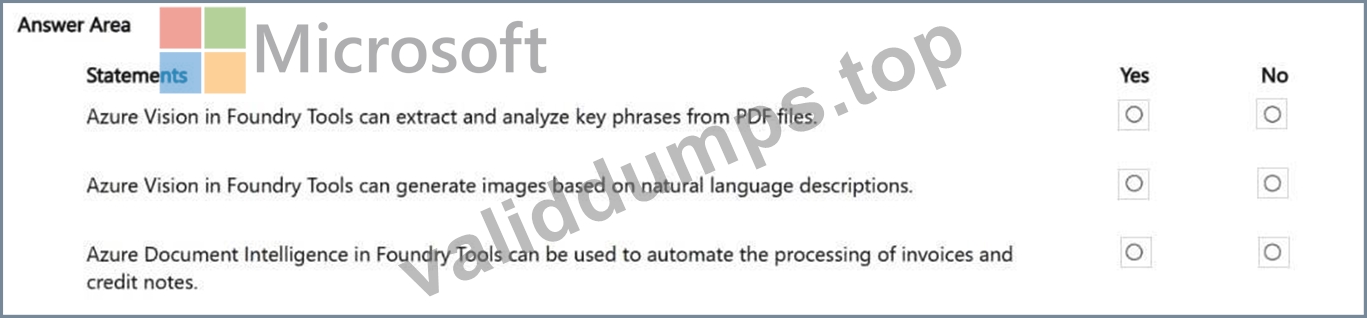
Answer:
Explanation: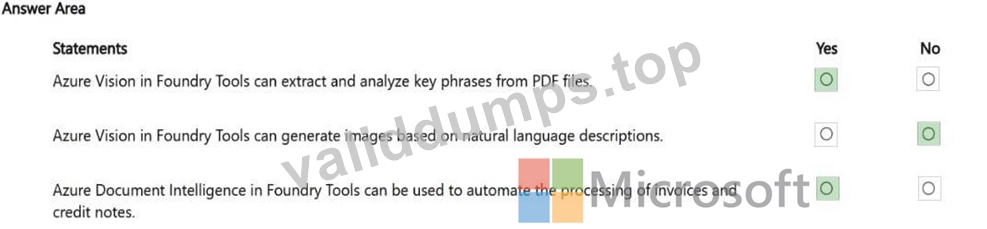
Explanation:
Box 1: Yes
Yes - Azure Vision in Foundry Tools can extract and analyze key phrases from PDF files.
Azure Document Intelligence (formerly part of Azure AI Services, now integrated into Azure AI Foundry Tools) can extract text, tables, and structures from PDF files.
While Azure Vision specifically handles Optical Character Recognition (OCR) for scanning text in images and documents, the combined capabilities within the Foundry ecosystem-particularly using Document Intelligence-allow for the extraction of structured data and, when combined with Azure Language services, the identification of key phrases and semantic information.
Box 2: No
No - Azure Vision in Foundry Tools can generate images based on natural language descriptions.
Azure Vision in Foundry Tools is designed for analyzing existing visual content rather than generating new images from scratch.
While the "Foundry" platform does offer image generation, it is typically handled by a separate image generation tool (currently in preview) that uses models like DALL-E Box 3: Yes Yes - Azure Document Intelligence in Foundry Tools can be used to automate the processing of invoices and credit notes.
Azure Document Intelligence in Foundry Tools (formerly part of Azure AI Services) is designed to automate the processing of invoices and credit notes, transforming unstructured documents into structured, actionable data within workflows.
It uses machine learning and Optical Character Recognition (OCR) to extract key fields (such as vendor name, invoice date, amounts, and tax information) and line items.
Reference:
https://azure.microsoft.com/en-in/products/ai-foundry/tools/document-intelligence
https://learn.microsoft.com/en-us/azure/ai-services/computer-vision/concept-describing-images
https://azure.microsoft.com/en-in/products/ai-foundry/tools/document-intelligence
NEW QUESTION # 68
Select the answer that correctly completes the sentence.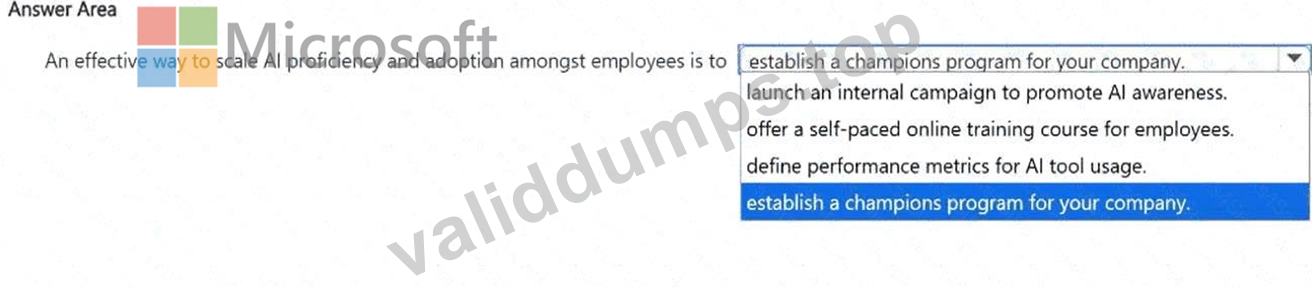
Answer:
Explanation: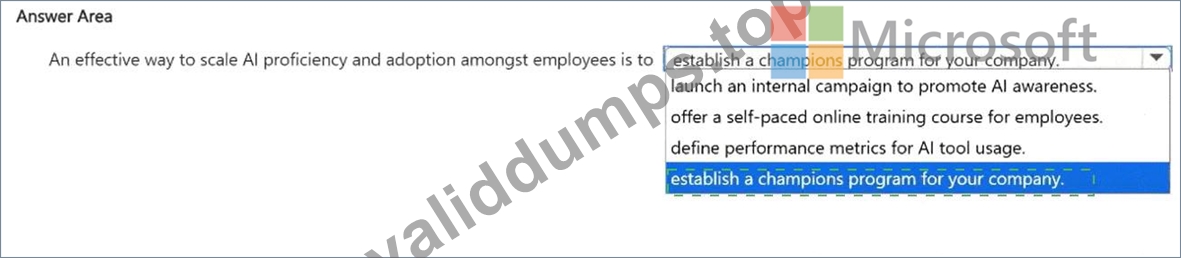
Explanation:
The correct answer is establish a champions program for your company. A champions program helps scale AI adoption because it creates a network of motivated employees who learn AI capabilities, share practical examples, support peers, and identify meaningful use cases within their departments. This is more effective than relying only on awareness campaigns or self-paced courses because champions create continuous peer-led adoption and practical reinforcement. Performance metrics are useful for measuring adoption, but metrics alone do not build confidence or capability. A champions program supports change management by turning early adopters into local advocates who can demonstrate value in real workflows, reduce resistance, gather feedback, and help employees understand how AI tools apply to their daily work.
NEW QUESTION # 69
For each of the following statements, select Yes if the statement is true. Otherwise, select No.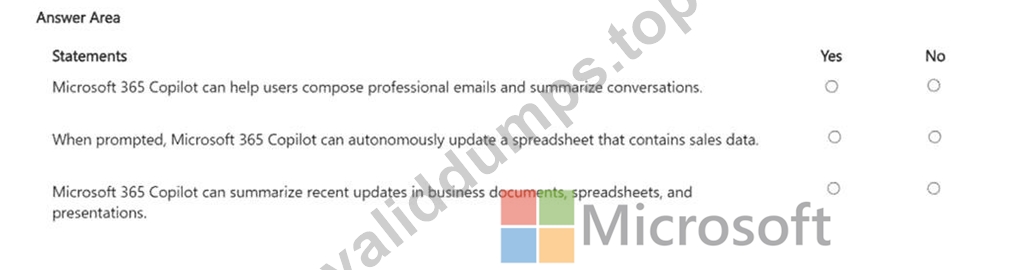
Answer:
Explanation: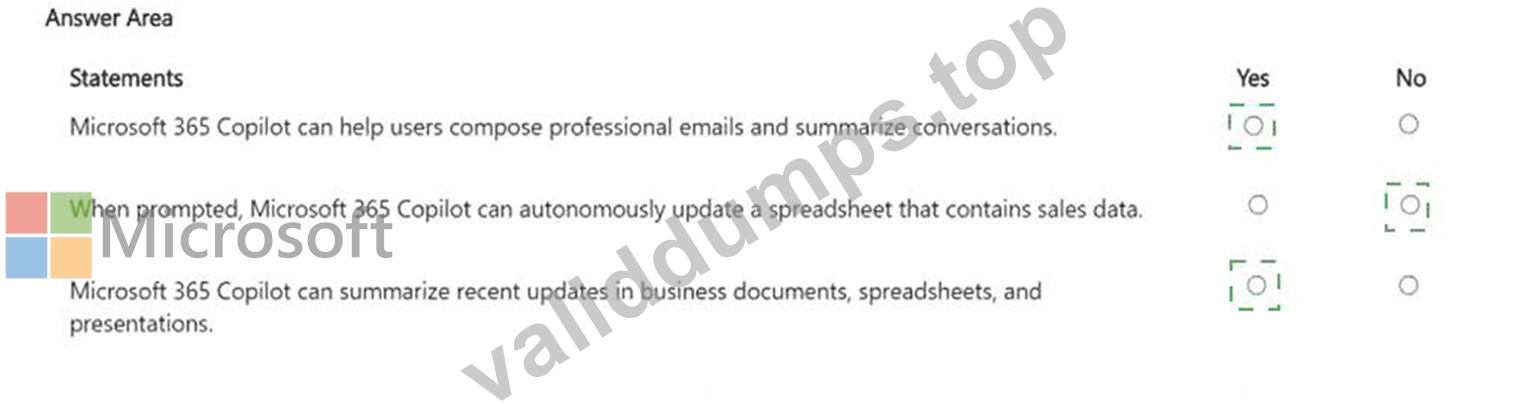
Explanation: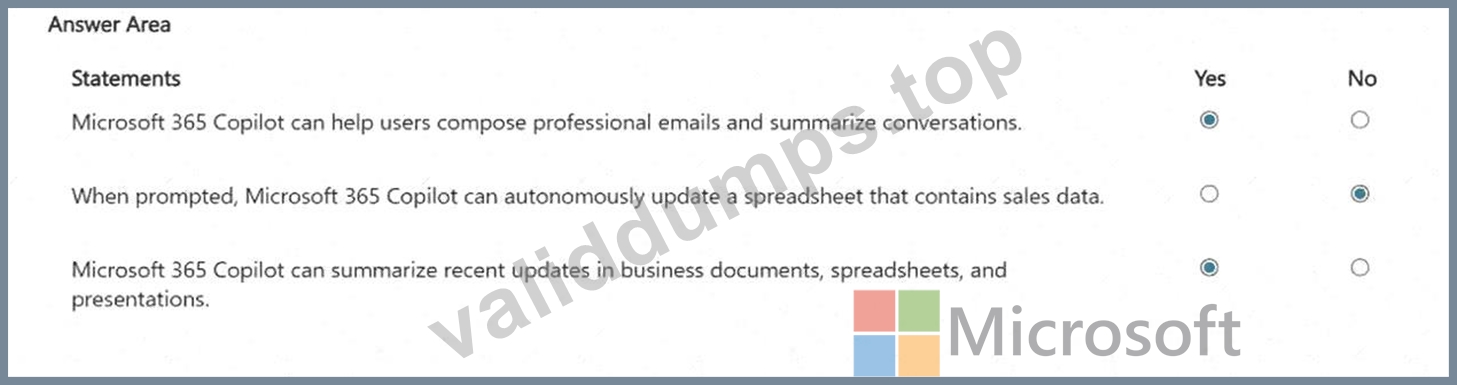
The correct selections are Yes, No, Yes. Microsoft 365 Copilot helps users create, rewrite, summarize, and analyze content in Microsoft 365 apps such as Outlook, Word, Excel, PowerPoint, and Teams. Therefore, it can help compose professional emails and summarize conversations. It can also summarize recent updates across business content such as documents, spreadsheets, and presentations when the user has access to that content. The second statement is false because Copilot is not generally described as autonomously updating business spreadsheets without user control. It can assist with analysis, formulas, summaries, and suggested changes, but autonomous modification of sales data would require governed user action, permissions, and potentially workflow controls. Copilot is an assistant, not an unrestricted autonomous spreadsheet operator.
NEW QUESTION # 70
Your company's HR department spends a large amount time answering repetitive questions and updating policy documents.
You need a solution that can automate employee interactions, respond to HR-related questions, and connect to internal business data sources.
What solution should you recommend?
- A. Microsoft Copilot in Azure
- B. Microsoft Copilot Studio
- C. Microsoft Security Copilot
- D. Microsoft 365 Copilot
Answer: B
Explanation:
Microsoft Copilot Studio is the most adequate solution for automating employee interactions, responding to HR-related questions, and connecting to internal business data sources.
Copilot Studio (formerly Power Virtual Agents) allows organizations to create custom AI agents or
"copilots" that can be embedded in Microsoft Teams, SharePoint, and other apps to provide self- service support.
Key Capabilities for HR & Internal Data
*-> Connecting to Internal Data Sources: Copilot Studio can connect to SharePoint, HRIS systems, SQL Server, and other databases to retrieve policy documents, payroll information, and employee data.
*-> Automating Employee Interactions: It creates conversational AI chatbots (often called
"AskHR" virtual agents) that handle routine queries, such as leave requests, benefits questions, and policy inquiries.
Intelligent Action and Workflow: Beyond just answering questions, Copilot Studio uses Generative AI to take actions, such as submitting time-off requests or updating employee records through Power Automate integrations.
Customization: It enables the creation of tailored agents (e.g., Onboarding Assistant, Leave Assistant, Policy Assistant) specifically for HR needs.
Reference:
https://www.synapx.com/boosting-internal-productivity-with-copilot-studio-support-bots
NEW QUESTION # 71
You need to recommend a service that supports indexing information and knowledge mining by extracting insights from documents. What should you recommend?
- A. Azure AI Search
- B. Azure Vision in Foundry Tools
- C. Azure Document Intelligence in Foundry Tools
- D. Microsoft Foundry
Answer: A
Explanation:
The requirement has two key phrases: indexing information and knowledge mining by extracting insights from documents . The Microsoft service purpose-built for this is Azure AI Search (formerly Azure Cognitive Search), which provides a search index over your content and supports "AI enrichment" workflows to extract and structure insights from documents during indexing.
Azure AI Search can ingest content from common enterprise sources (files, blobs, databases), build searchable indexes, and enrich the indexed content using built-in skills or integrated AI capabilities-such as entity recognition, key phrase extraction, language detection, and OCR (depending on the pipeline). This is exactly what "knowledge mining" refers to: turning large volumes of unstructured documents into structured, searchable knowledge that applications and users can query.
The other choices are partial fits: Azure Vision focuses on image/video analysis, not general document indexing. Azure Document Intelligence is excellent for extracting fields/tables from forms and documents, but on its own it does not provide the full indexing/search and knowledge mining layer across a corpus.
Microsoft Foundry is an overarching platform for building AI apps/agents; it can incorporate search, but the specific service that directly delivers indexing + knowledge mining is Azure AI Search .
NEW QUESTION # 72
Match the business scenario to the appropriate AI solution design approach. Each solution may be used once, more than once, or not at all.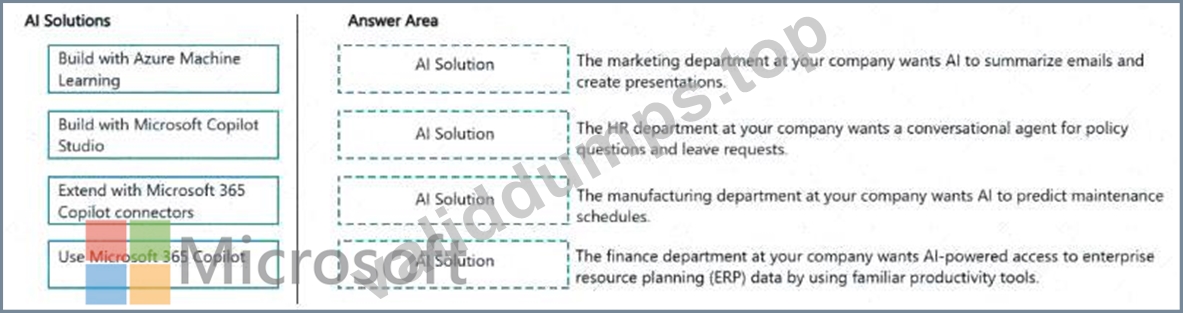
Answer:
Explanation: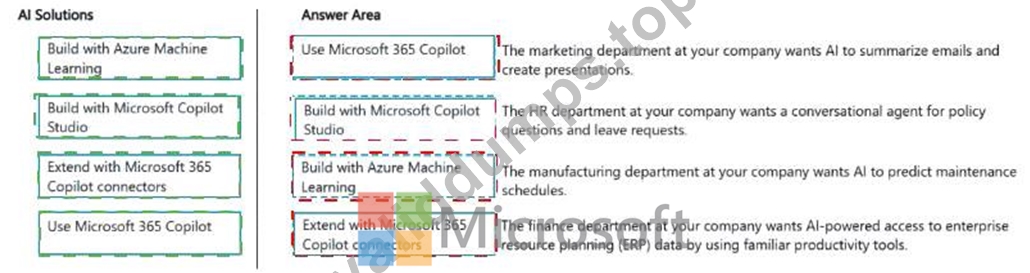
Explanation:
* The marketing department at your company wants AI to summarize emails and create presentations.
The answer: Use Microsoft 365 Copilot
* The HR department at your company wants a conversational agent for policy questions and leave requests. Answer: Build with Microsoft Copilot Studio
* The manufacturing department at your company wants AI to predict maintenance schedules. Answer:
Build with Azure Machine Learning
* The finance department at your company wants AI-powered access to enterprise resource planning ERP data by using familiar productivity tools. Answer: Extend with Microsoft 365 Copilot connectors These scenarios map to four distinct solution patterns: out-of-the-box productivity assistance, low-code conversational agents, predictive ML, and enterprise data integration.
Marketing's need to summarize emails and create presentations is a core "productivity copilot" use case.
Microsoft 365 Copilot is embedded in Outlook, Word, PowerPoint, and Teams, so it directly supports summarization, drafting, and presentation generation without building a custom solution-making Use Microsoft 365 Copilot the best fit.
HR's requirement is a conversational agent tailored to internal policies and workflows such as leave requests.
That typically needs custom dialog, grounded knowledge sources, and possibly actions/workflows. Microsoft Copilot Studio is designed to build and manage such agents with organizational knowledge and business process integration, so Build with Microsoft Copilot Studio fits best.
Manufacturing's predictive maintenance scheduling is classic predictive analytics: learning patterns from historical telemetry/maintenance data to forecast failures or optimal service windows. This is best addressed with Azure Machine Learning , which supports training, evaluating, and deploying custom predictive models.
Finance wants AI-powered access to ERP data "using familiar productivity tools," which implies bringing external line-of-business data into the Microsoft 365 Copilot experience. That is precisely where Microsoft
365 Copilot connectors help-indexing and exposing enterprise data sources so Copilot can reference them in a governed way-so Extend with Microsoft 365 Copilot connectors is the best approach.
NEW QUESTION # 73
You plan to meet with a group of stakeholders to discuss how generative AI can benefit your company. You need to provide the stakeholders with a relevant description of generative AI during the meeting. Which description should you use?
- A. Generative AI is designed to generate responses based on a user ' s natural language prompts.
- B. Generative AI is designed to recommend products based on user behavior.
- C. Generative AI is designed to predict future trends based on historical data.
- D. Generative AI is designed to translate documents into other languages.
Answer: A
Explanation:
Generative AI's defining characteristic is that it creates new content (text, images, code, summaries, drafts) in response to instructions-most commonly natural language prompts. Option C captures that general- purpose description in a stakeholder-friendly way: users provide prompts and the system generates responses or content. This framing is broad enough to cover common business value scenarios such as summarizing documents, drafting communications, creating marketing copy, generating reports, building assistants, and producing structured outputs from unstructured requests.
Option A is a single use case (translation), not the defining description. Option B describes predictive analytics
/forecasting, which is a different AI category focused on outcomes and probabilities rather than content creation. Option D describes recommendation systems, typically driven by ranking/behavioral signals; while AI can enhance recommendations, that is not the core definition of generative AI. Therefore, the most accurate and relevant description for stakeholders is C.
NEW QUESTION # 74
You have a business unit that uses an AI solution to process loan applications. You discover that the solution rejects the application of all applicants that are older than 60 years of age. Which Microsoft responsible AI principle is this violating?
- A. transparency
- B. reliability and safety
- C. accountability
- D. fairness
Answer: D
Explanation:
This scenario is a clear violation of the fairness principle. Fairness in Microsoft's Responsible AI framework is about ensuring AI systems do not create unjustified bias or discriminatory outcomes-especially when decisions affect people's access to opportunities such as credit, employment, housing, or education. A rule or learned behavior that rejects all applicants over a certain age creates a systematic, categorical disadvantage for a protected demographic group and indicates a discriminatory decision boundary rather than an individualized assessment of creditworthiness.
Even if the model designers believed age correlates with risk, using a hard cutoff that rejects every applicant older than 60 is not an equitable approach. It suggests the model is either using age directly as a dominant feature or reflects biased training data/labels that encoded discriminatory outcomes. Fairness requires you to evaluate model outcomes across groups (for example, age brackets), measure disparate impact, and apply mitigations such as feature review (removing or constraining sensitive attributes), rebalancing training data, adjusting thresholds, or using fairness-aware training/evaluation methods. It also requires governance and review of high-stakes automated decisions.
The other principles are not the best match: transparency concerns explainability and user understanding, accountability concerns human oversight and ownership, and reliability and safety concerns consistent and safe operation. The core issue here is discriminatory treatment across an age group- fairness .
NEW QUESTION # 75
- For each of the following statements, select Yes if the statement is true. Otherwise, select No. NOTE: Each correct selection is worth one point.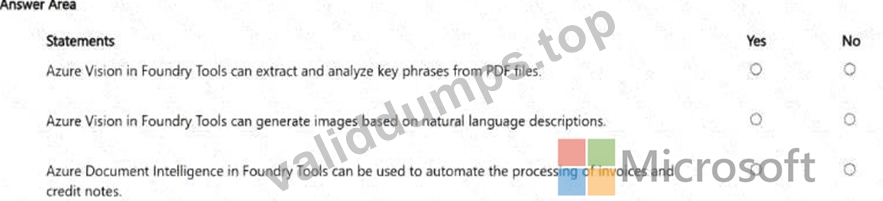
Answer:
Explanation: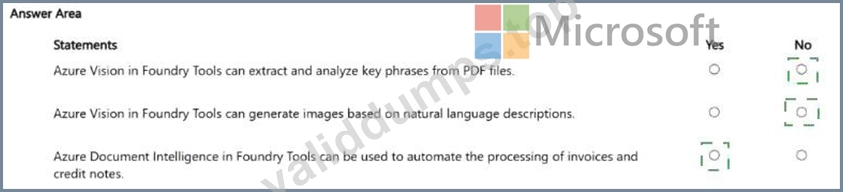
Explanation:
Answer Area
* Azure Vision in Foundry Tools can extract and analyze key phrases from PDF files. Answer: No
* Azure Vision in Foundry Tools can generate images based on natural language descriptions. Answer:
No
* Azure Document Intelligence in Foundry Tools can be used to automate the processing of invoices and credit notes. Answer: Yes
* No - Azure Vision in Foundry Tools focuses on computer vision tasks such as image analysis and OCR (reading text from images and documents). While it can extract text from scanned PDFs via OCR, key phrase extraction is a natural language processing capability provided by Azure Language in Foundry Tools , not Azure Vision. Key phrase extraction analyzes text to identify main concepts, which is a different service family than vision.
* No - Azure Vision can analyze existing images (for example, generate captions/descriptions of an image), but generating new images from a text prompt is a generative model capability (for example, DALL E through Azure OpenAI/Azure AI Foundry model endpoints), not an Azure Vision feature.
Vision describes what it "sees"; it doesn't synthesize new images from natural language.
* Yes - Azure Document Intelligence in Foundry Tools is designed for intelligent document processing
, including automating extraction of structured fields from financial documents. Microsoft provides prebuilt models for invoices and supports custom extraction for similar document types, which makes it suitable for automating workflows involving invoices and credit-note style documents (field extraction, validation, routing).
NEW QUESTION # 76
What is a key feature of Microsoft 365 Copilot that aligns with the Microsoft responsible AI principles of transparency, reliability, and safety?
- A. Enables users to select from an authorized catalog of AI models.
- B. Removes the need for a human to review AI-generated outputs.
- C. Provides grounded, verifiable responses based on organizational data.
- D. Automatically approves AI-generated content for company-wide publishing.
Answer: C
Explanation:
By using Retrieval-Augmented Generation (RAG), Microsoft 365 Copilot ensures that its responses are not just creative guesses, but are anchored in your specific organizational context-
-such as your emails, documents, and chats.
This "grounding" process is fundamental because it:
Reduces Hallucinations: It prioritizes your data over general internet knowledge.
Ensures Permissioning: It only accesses data the specific user already has the right to see.
Maintains Transparency: It typically provides citations so you can verify the source of the information.
Reference:
https://medium.com/@praneetsy/rag-in-microsoft-365-copilot-how-retrieval-makes-ai-business-aware-e77f8ee77c7c
NEW QUESTION # 77
Your company receives thousands of scanned invoices each month. You need to recommend an AI solution that can automatically extract key details, such as invoice numbers, vendor names, and total amounts. What is the best solution to recommend? More than one answer choice may achieve the goal. Select the BEST answer.
- A. Azure Machine Learning
- B. Azure Document Intelligence in Foundry Tools
- C. Azure Vision in Foundry Tools
- D. Azure AI Search
Answer: B
Explanation:
For scanned invoices, the requirement is structured field extraction (invoice number/ID, vendor, totals) from document images or PDFs at scale. The best fit is Azure Document Intelligence because it is purpose- built for document processing and provides prebuilt invoice models that combine OCR with layout/structure understanding to extract common invoice fields into a structured output. Microsoft's invoice model is explicitly designed to analyze invoices (including scanned images) and return key fields and line items in structured form, which directly maps to this scenario.
Azure Vision (B) can perform OCR and basic image analysis, but OCR alone typically returns text without robust invoice-specific field interpretation (e.g., reliably identifying "Invoice ID" vs. "Order ID," totals vs.
subtotals, vendor vs. ship-to). Document Intelligence is optimized for advanced document structure extraction and is therefore the "best" single recommendation.
Azure AI Search (C) focuses on indexing and retrieval/knowledge mining across a corpus; it's not the primary service for extracting invoice fields for downstream processing. Azure Machine Learning (D) could be used to build a custom model, but that adds cost and time compared with a prebuilt invoice extractor designed for this document type.
NEW QUESTION # 78
Your company wants to ensure that AI solutions are used responsibly and align with company values and compliance requirements.
You need to establish governance principles for AI use.
Which two actions should you perform? Select the two BEST answers. Each correct answer presents a complete solution.
- A. Allow each department to tailor governance processes for its own AI initiatives.
- B. Assign governance ownership primarily to the AI engineering and data science teams.
- C. Define accountability norms for AI decisions across business and technical teams.
- D. Focus governance efforts on AI systems that handle regulated or sensitive data.
- E. Create a process to review AI initiatives for responsible AI alignment.
Answer: C,E
Explanation:
The correct answers are A and E. A governance program should include a formal process to review AI initiatives for responsible AI alignment. This ensures that projects are assessed for fairness, privacy, security, reliability, transparency, accountability, and business risk before deployment and during operation. Defining accountability norms across business and technical teams is also essential because responsible AI cannot be owned only by engineers or data scientists. Business owners, legal, compliance, security, privacy, and technical teams must understand who approves AI use cases, who monitors outcomes, and who responds when issues occur. Letting departments use separate governance methods creates inconsistency. Focusing only on regulated or sensitive-data systems is too narrow.
NEW QUESTION # 79
Hotspot Question
For each of the following statements, select Yes if the statement is true. Otherwise, select No.
NOTE: Each correct selection is worth one point.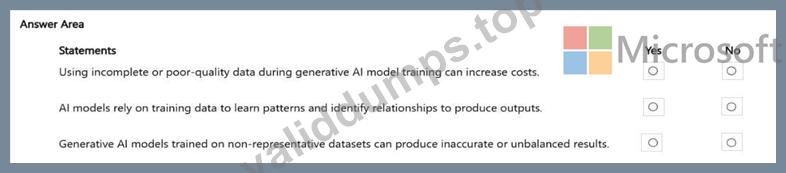
Answer:
Explanation: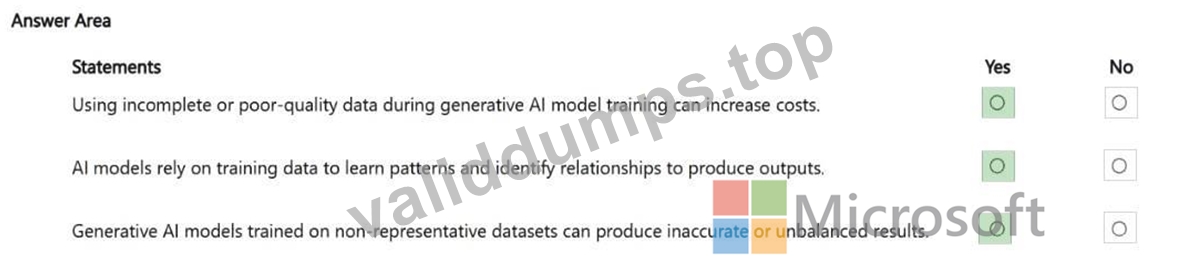
Explanation:
Box 1: Yes
Yes - Using incomplete or poor-quality data during generative AI model training can increase costs.
Using incomplete or poor-quality data during generative AI (GenAI) model training significantly increases costs, acting as a major cause of project failure and inefficiencies. This phenomenon is driven by the "garbage in, garbage out" principle, where flawed inputs lead to, at best, unreliable outputs and, at worst, extensive, costly, and time-consuming remediation.
Box 2: Yes
Yes - AI models rely on training data to learn patterns and identify relationships to produce outputs.
At their core, AI models function like pattern-recognition engines; they don't "know" things in the human sense, but rather calculate the statistical likelihood of what should come next based on the data they've processed.
The quality and variety of that training data directly dictate how nuanced and accurate those relationships become. This is why we see such a massive leap between models trained on small, specific datasets versus Large Language Models (LLMs) trained on the vast diversity of the internet.
Box 3: Yes
Yes - Generative AI models trained on non-representative datasets can produce inaccurate or unbalanced results.
When generative AI models are trained on non-representative datasets, they often inherit and amplify existing societal prejudices, leading to systematic distortions known as representation bias. These models fail to generalize fairly across broader populations, resulting in outputs that marginalize or inaccurately depict minority groups.
NEW QUESTION # 80
Hotspot Question
For each of the following statements, select Yes if the statement is true. Otherwise, select No.
NOTE: Each correct selection is worth one point.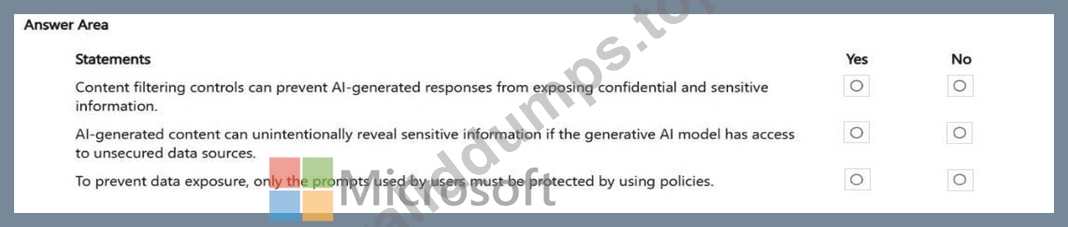
Answer:
Explanation: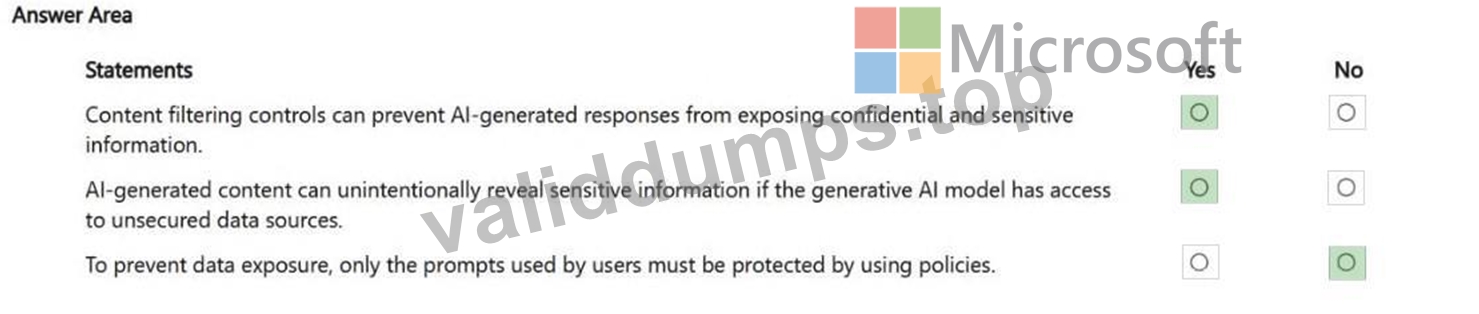
Explanation:
Box 1: Yes
Yes - Content filtering controls can prevent AI-generated responses from exposing confidential and sensitive information.
Content filtering controls are a critical safeguard for preventing AI-generated responses from inadvertently exposing confidential or sensitive information. These controls operate as
"guardrails" by inspecting data at both the input (prompt) and output (completion) stages.
Box 2: Yes
Yes - AI-generated content can unintentionally reveal sensitive information if the generative AI model has access to unsecured data source.
Unsecured data sources significantly increase the risk of AI-generated content exposing sensitive information through several mechanisms. Because generative AI models are "data-hungry" and often lack transparent data boundaries, they can absorb and later reproduce confidential data they were exposed to during training or operation.
Box 3: No
No - To prevent data exposure, only the prompts used by users must be protected by using policies.
While protecting user prompts is a critical first step, it is not sufficient on its own to prevent data exposure. Relying solely on prompt policies leaves significant gaps where sensitive data can still leak through other vectors.
Reference:
https://noma.security/resources/ai-application-security/
https://pacific.ai/managing-privacy-risks-llm-guidance/
https://www.paloaltonetworks.com/blog/network-security/securing-the-future-by-protecting- sensitive-data-in-ai-systems
NEW QUESTION # 81
Which business requirement most closely relates to grounding a generative AI model?
- A. enabling users to interact by using natural language queries
- B. supporting multiple languages
- C. measuring the number of user interactions per day
- D. ensuring that verified company data sources are used for response generation
Answer: D
NEW QUESTION # 82
Hotspot Question
For each of the following statements, select Yes if the statement is true. Otherwise, select No.
NOTE: Each correct selection is worth one point.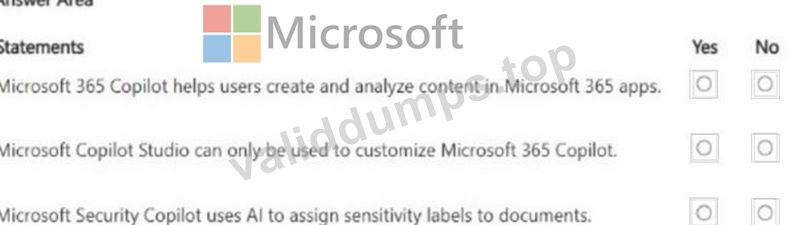
Answer:
Explanation: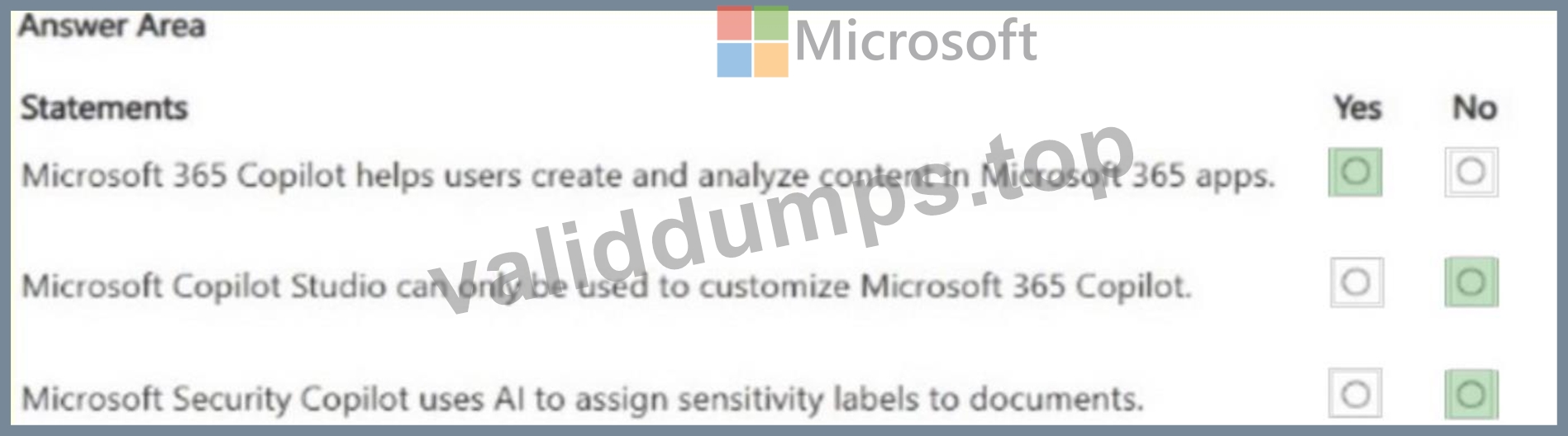
Explanation:
Box 1: Yes
Microsoft 365 Copilot is directly embedded within daily office productivity applications (such as Word, Excel, PowerPoint, Outlook, and Teams) to natively assist users in drafting text, summarizing long email threads, and analyzing data patterns.
Box 2: No
While Copilot Studio can be used to extend Microsoft 365 Copilot, it is not its exclusive purpose.
Copilot Studio is an independent low-code development platform that allows you to build completely standalone custom conversational bots, web chat agents, and automated voice response systems deployed to external websites, mobile apps, or Facebook Messenger.
Box 3: No
Automatically assigning data classification and sensitivity labels (such as "Confidential" or
"Public") to enterprise documents is the role of Microsoft Purview Information Protection.
Microsoft Security Copilot (now Copilot for Security) focuses instead on defensive cybersecurity operations, such as summarizing incident alerts, analyzing malicious scripts, and assisting security analysts with threat hunting.
NEW QUESTION # 83
An organization is deploying generative AI solutions and wants to ensure systems are explainable, auditable, and accountable to stakeholders. Why is this focus critical when implementing AI?
- A. It ensures AI systems operate transparently and can be trusted
- B. It improves GPU processing efficiency
- C. It automates infrastructure provisioning
- D. It eliminates the need for compliance reviews
Answer: A
Explanation:
Transparency and accountability are core Responsible AI principles that ensure AI systems can be understood, governed, and trusted by users and stakeholders.
Reference:
https://www.microsoft.com/en-us/ai/responsible-ai
NEW QUESTION # 84
Your company uses a generative AI solution.
You need to improve the quality of responses by using grounding.
Which statement accurately describes how grounding improves accuracy and relevancy?
- A. specifies the strengths and weaknesses of the AI model
- B. anchors the responses in specific data sources
- C. references a diverse set of people, disciplines, and perspectives
- D. explains how and why AI models generate content
Answer: B
Explanation:
Grounding is a critical technique for improving the accuracy and relevance of generative AI solutions by linking or "anchoring" the large language model's (LLM) outputs to specific, verified, and up-to-date data sources. Without grounding, LLMs rely on their pre-trained, static, and often outdated knowledge, leading to "hallucinations"-confidently generated but incorrect, irrelevant, or fabricated information.
How Grounding Improves Accuracy and Relevance
Grounding transforms a general-purpose AI into a specialized, trustworthy, and actionable tool by providing the following benefits:
Reduces Hallucinations: By forcing the model to anchor its responses in provided data-such as internal documents, databases, or live web searches-grounding significantly reduces the likelihood of the model creating false information.
Enhances Contextual Relevance: Grounded models can access domain-specific, private data (e.g., CRM records, internal wikis, proprietary PDFs) rather than just public, general knowledge.
Ensures Data Freshness: Instead of relying on a static, old training cut-off date, grounding (often via Retrieval-Augmented Generation or RAG) enables the model to access the latest, real-time information, such as current inventory, updated policies, or recent news.
Provides Auditability and Trust: Grounded systems frequently provide citations or links to the exact source material used to generate the answer, allowing users to verify the information and increasing trust in the system.
Reference:
https://portkey.ai/blog/llm-grounding-for-accurate-outputs/
NEW QUESTION # 85
......
Updated Test Engine to Practice AB-731 Dumps & Practice Exam: https://pass4sure.validdumps.top/AB-731-exam-torrent.html