


UiPath-ADPv1 Exam Dumps - Try Best UiPath-ADPv1 Exam Questions from Training Expert ValidDumps
Practice Examples and Dumps & Tips for 2025 Latest UiPath-ADPv1 Valid Tests Dumps
NEW QUESTION # 63
Given the following workflow: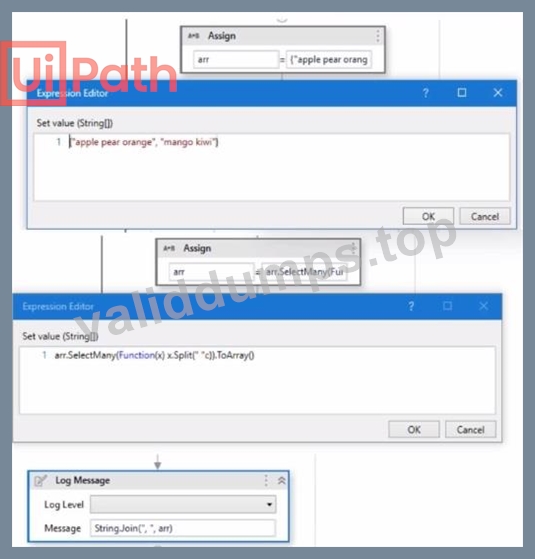
What will be the output of the Log Message activity?
- A. "apple pear orange", "mango kiwi"
- B. apple pear orange, mango kiwi
- C. apple, pear, orange
- D. apple, pear, orange, mango, kiwi
Answer: D
NEW QUESTION # 64
A developer has created a variable of type String called "MyNumbers" and assigned to it the following value:
"1. 2, 3.4, 5. 6". What is the resulting data type for the expression MyNumbers.Split("."c)(1)?
- A. Double
- B. Array of String
- C. String
- D. lnt32
Answer: C
Explanation:
When the Split method is used on a String variable, the result is an array of substrings. However, accessing a specific element of this array (e.g., MyNumbers.Split("."c)(1)) returns a single substring, which is a String.
NEW QUESTION # 65
A developer is using the REFramework template to automate a process. In "SetTransactionStatus" file, there is the following sequence of activities, where the last Log Message activity was added by the developer: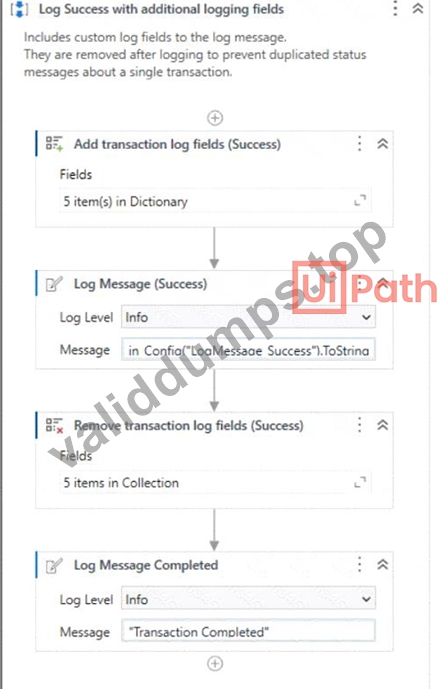
The configuration for Add Log Fields and Remove Log Fields activities are shown below:
Add transaction log fields (Success)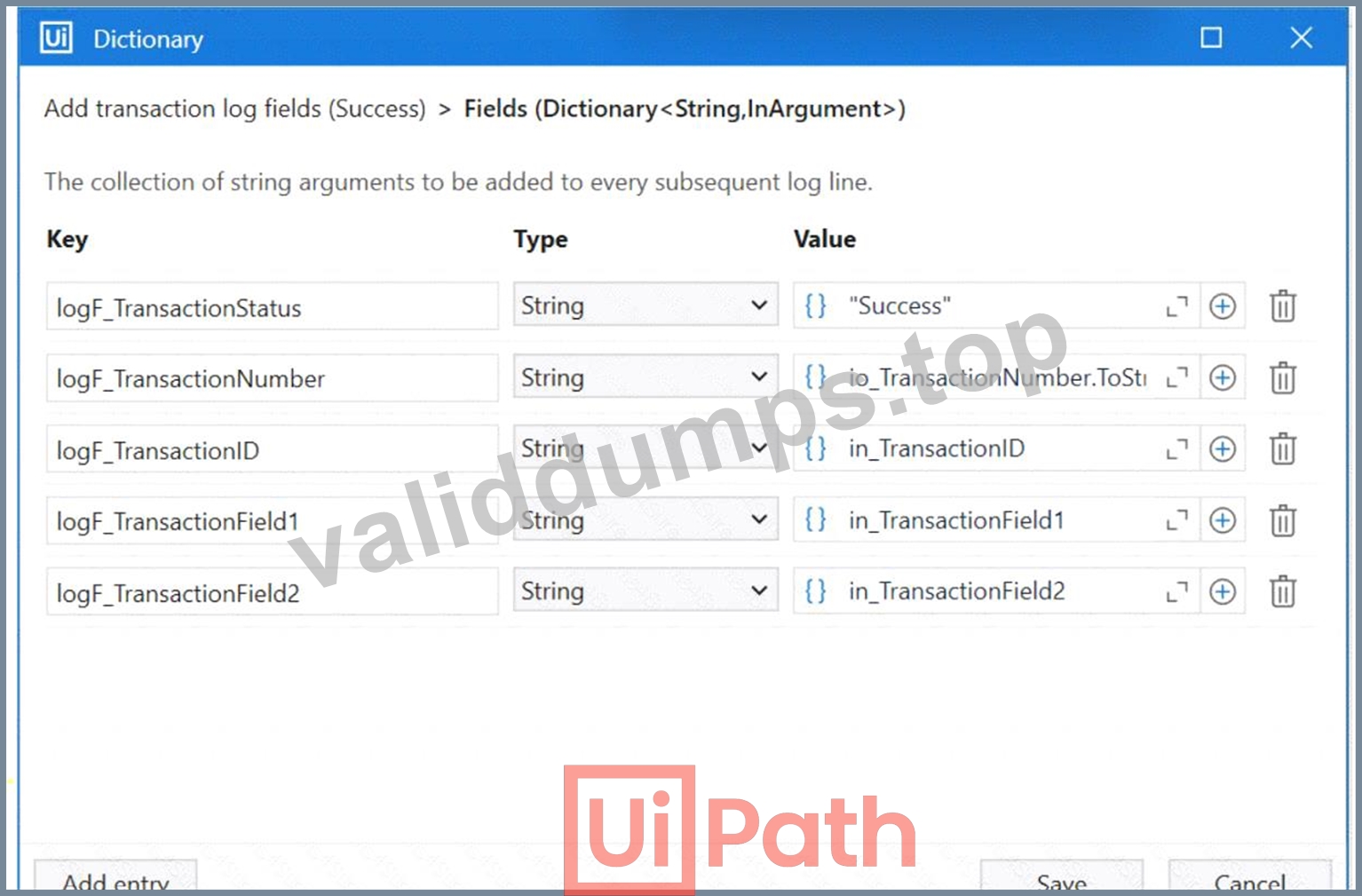
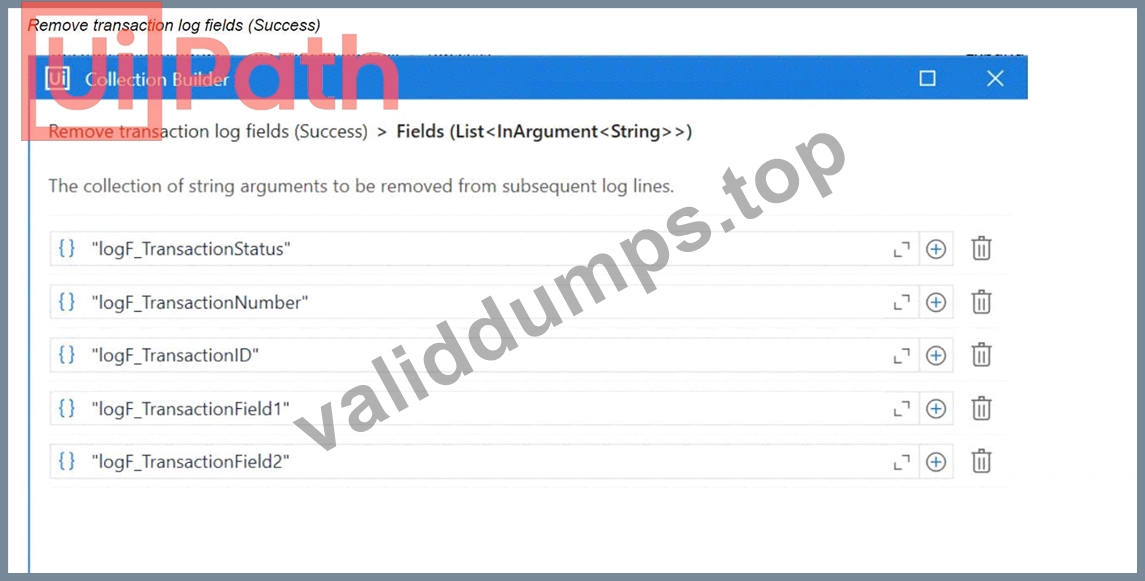
The developer runs the process and notices the argument values for the first transaction are:
in_TransactionID = "07/18/2023 10:27:29"
io_TransactionNumber = 1
in_TransactionField1 = "UI235-80"
in_TransactionField2 = "Update Request"
Which of the following Log Message Details will be displayed when executing the activity Log Message Completed for the first transaction, considering it is successful?
- A. {
"message": "Transaction Completed",
"level": "Information",
"logType": "User",
"timeStamp": "10:30:19",
"fileName": "SetTransactionStatus",
"processVersion": "1.0.0",
"jobId": "cb865477-35f8-4c0a-93e9-e4f4246223f2",
"robotName": "test.robot",
"machineId": 0,
"logF_TransactionField2": "Update Request",
"logF_TransactionID": "07/18/2023 10:27:29",
"logF_BusinessProcessName": "Framework",
"logF_TransactionNumber": "1",
"logF_TransactionField1": "UI235-80",
"logF_TransactionStatus": "Success"
} - B. {
"message": "Transaction Completed",
"level": "Information",
"logType": "User",
"timeStamp": "10:30:19",
"fileName": "SetTransactionStatus",
"processVersion": "1.0.0",
"jobId": "59325301-680a-4d55-a81b-56ca1f369c12",
"robotName": "test.robot",
"machineId": 0,
"logF_TransactionField2": "",
"logF_TransactionStatus": "",
"logF_TransactionID":
"logF_BusinessProcessName": "Framework",
"logF_TransactionNumber": "",
"logF_TransactionField1": ""
} - C. {
"message": "Transaction Completed",
"level": "Information",
"logType": "User",
"timeStamp": "10:30:19",
"fileName": "SetTransactionStatus",
"processVersion": "1.0.0",
"jobId": "f8a36a46-8ebc-40df-8f71-26b39087ebee",
"robotName": "test.robot",
"machineId": 0,
"logF_BusinessProcessName": "Framework"
} - D. {
"message": "Transaction Completed",
"level": "Information",
"logType": "User",
"timeStamp": "10:30:19",
"fileName": "SetTransactionStatus",
"processVersion": "1.0.0",
"jobId": "59325301-680a-4d55-a81b-56ca1f369c12",
"robotName": "test.robot",
"machineId": 0,
"logF_TransactionField2": empty,
"logF_TransactionStatus": empty,
"logF_TransactionID": empty,
"logF_BusinessProcessName": "Framework",
"logF_TransactionNumber": empty,
"logF_TransactionField1": empty
}
Answer: C
Explanation:
In the REFramework, the Add Log Fields activity is used to append additional information to the log messages. This information is stored in the form of custom fields. In this scenario, Add Log Fields (Success) activity is adding several fields with the transaction details whenever a transaction is successful.
The Remove Log Fields activity is then used to delete these custom fields to prevent them from appearing in subsequent log messages. This is important to ensure that only relevant information is logged for each transaction and to avoid cluttering the logs with outdated information.
When the Log Message Completed activity is executed after the Remove Log Fields activity, it should log the message without the additional fields that were added by the Add Log Fields activity since they have been removed. This means that the log message should only include the standard fields like message, level, logType, timeStamp, fileName, processVersion, jobId, robotName, and machineId, without the custom fields like logF_TransactionStatus, logF_TransactionNumber, etc.
Based on the options provided and the understanding of the REFramework's logging mechanism, the correct answer should be:
D: { "message": "Transaction Completed", "level": "Information", "logType": "User", "timeStamp":
"10:30:19", "fileName": "SetTransactionStatus", "processVersion": "1.0.0", "jobId":
"f8a36a46-8ebc-40df-8f71-26b39087ebee", "robotName": "test.robot", "machineId": 0,
"logF_BusinessProcessName": "Framework" }
This option is correct because it shows a log message after the removal of custom fields, retaining only the logF_BusinessProcessName field, which wasn't specified to be removed according to the provided information.
NEW QUESTION # 66
How are custom log fields used in the REFramework?
- A. Customlog fieldsareusedto automatically retry failed transactions with real-time updates.
- B. Customlog fieldsareusedto define the variable types for transactions, replacing the default Queueitemtype.
- C. Customlog fieldsareusedto store sensitive information like credentials and personal data of users.
- D. Customlog fieldsareincluded in log messages and used to add more data about each transaction for reporting and troubleshooting purposes.
Answer: D
Explanation:
Custom log fields are additional fields that can be added to the Robot Execution Logs using the Add Log Fields activity1. The REFramework is a template for creating robust and scalable automation projects that uses the State Machine workflow type2. The REFramework leverages the custom log fields feature to include more information about each transaction in the log messages, such as the transaction number, the transaction item, the business process name, etc. This helps to improve the reporting and troubleshooting capabilities of the automation project, as the custom log fields can be easily viewed and filtered in the Output panel, the Orchestrator Logs page, or any external logging tool3.
Option A is incorrect, because custom log fields are not used to automatically retry failed transactions, but rather to provide more details about them. The REFramework uses the Retry Scope activity and the Set Transaction Status activity to handle the retry mechanism for failed transactions4. Option B is incorrect, because custom log fields are not used to store sensitive information, but rather to enhance the log messages.
Storing sensitive information like credentials and personal data of users in the log fields is not recommended, as it may pose a security risk. Option C is incorrect, because custom log fields are not used to define the variable types for transactions, but rather to add more data about them. The REFramework uses the TransactionItem argument to store the transaction data, which can be of any type, such as QueueItem, DataRow, String, etc.
References: 1: Add Log Fields 2: The UiPath ReFramework 3: Add Log Field Advantages 4: Retry Scope :
[Logging and Log Levels] : [TransactionItem Argument]
NEW QUESTION # 67
What are the steps to publish a project from UiPath Studio?
Instructions: Drag the Description found on the "Left" and drop on the correct Step Sequence found on the
"Right".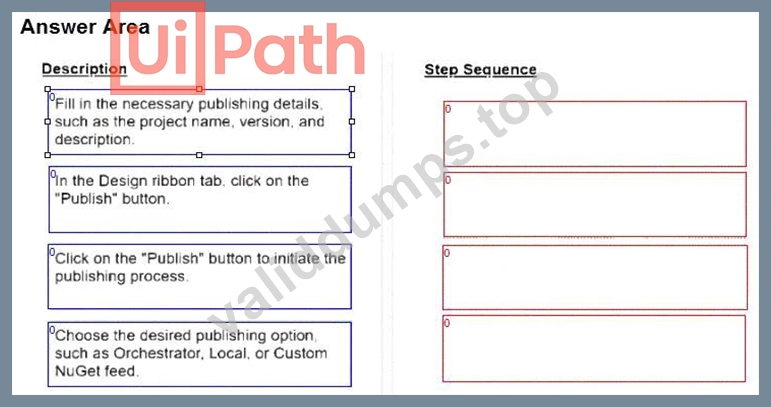
Answer:
Explanation: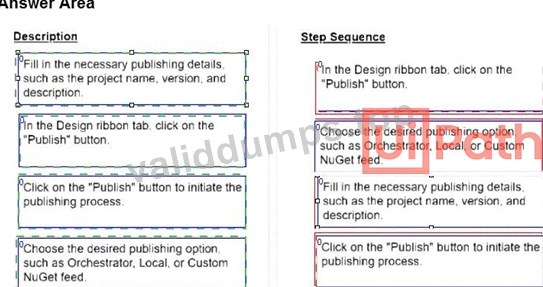
Explanation: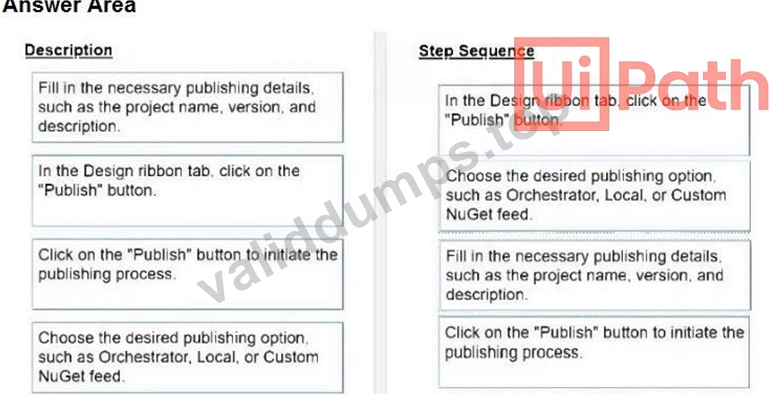
NEW QUESTION # 68
A developer needs to create a repetitive process in the REFramework. Following the best practices, which action(s) should be performed to defend against potential robot crashes such as "out of memory"?
- A. Build a script that compares current CPU usage values to a threshold and clears data as needed.
- B. After every transaction, clear the transaction data, close the applications, and re-open the applications.
- C. Add a "Clear Collection" activity at the beginning of the Process.xaml workflow.
- D. All "Invoke Workflow File" activities from the Main.xaml file should be marked with the Isolated option.
Answer: D
Explanation:
The best practice for creating a repetitive process in the REFramework and defending against potential robot crashes such as "out of memory" is to mark all "Invoke Workflow File" activities from the Main.xaml file with the Isolated option. The Isolated option enables the workflow to run in a separate process, which reduces the memory consumption and the risk of memory leaks. It also improves the stability and the performance of the robot, as it isolates the errors and the exceptions that might occur in the invoked workflow. The Isolated option can be found in the Properties panel of the "Invoke Workflow File" activity, under the Options category. By marking all the invoked workflows as Isolated, the developer can ensure that the robot can handle a large number of transactions without crashing or slowing down
NEW QUESTION # 69
In an RPA Testing project, you created the mock "MySequencemock" for the file "MySequence". You have to update "MySequence" and add a Log Message activity and a Verify Expression activity.
What will happen to "MySequencemock" file when you save the project, assuming that the file is closed?
- A. The changes made in "MySequence" workflow file are applied to the mock file.
- B. Only the Log Message activity will be added to the mock file.
- C. Only the Verify Expression activity will be added to the mock file.
- D. The changes made in "MySequence" workflow file are not applied to the mock file.
Answer: A
Explanation:
A mock file is a copy of a workflow file that is used for testing purposes, where some activities are replaced by mock activities that simulate the expected behavior1. A mock file can be created by selecting Mock workflow under test in the Create Test Case window2. The mock file is stored in the Project > Mocks folder, and it has the same name as the original workflow file, with the suffix "_mock" added2. For example, if the original workflow file is named "MySequence.xaml", the mock file will be named "MySequence_mock.
xaml".
When a mock file is created, the changes made in the original workflow file are automatically applied to the mock file when the project is saved2. This means that any new activities or modifications in the original workflow file are reflected in the mock file, except for the activities that are surrounded by mock activities2.
The mock activities are not affected by the changes in the original workflow file, and they can only be edited within the mock file2.
Therefore, if you update "MySequence" and add a Log Message activity and a Verify Expression activity, and then save the project, the changes will be applied to the mock file, assuming that the file is closed. This means that the mock file will also have the Log Message activity and the Verify Expression activity added, unless they are inside a mock activity
NEW QUESTION # 70
A developer implemented a process using the Robotic Enterprise Framework and an Orchestrator queue. The MaxRetryNumber from the "Config.xlsx" file is set to "1" and the Max # of retries from the Queue settings from Orchestrator is set to "2". At runtime, the first transaction item throws a Business Exception.
How many times will the transaction be retried?
- A. The transaction will be retried multiple times, until it will be processed successfully.
- B. The transaction will be retried 2 times.
- C. The transaction will not be retried.
- D. The transaction will be retried only one time.
Answer: D
NEW QUESTION # 71
An error occurs during the Initialization state within the #'FrameworkMnitAIISettings.xaml" file for a process using REFramework which is executed on Orchestrator. The project contains default values for the settings specified in "Config.xlsx".
What is the current state of the job in Orchestrator?
- A. Stopped
- B. Faulted
- C. Successful
- D. Suspended
Answer: B
Explanation:
The current state of the job in Orchestrator is Faulted, because an error occurred during the Initialization state of the process using REFramework. The REFramework is a template for creating robust and scalable automation projects that uses the State Machine workflow type1. The Initialization state is the first state in the REFramework, which is responsible for initializing the application, reading the configuration file, and setting the log level2. If an error occurs during the Initialization state, the process will go to the End Process state, which will perform the final actions and close the application2. The End Process state will also mark the job as Faulted in Orchestrator, if the value of the ShouldMarkJobAsFaulted argument is True2. The default value of this argument in the REFramework is True, unless it is changed in the Config.xlsx file or in the Orchestrator assets3.
Option A is incorrect, because the job is not Successful, as an error occurred during the Initialization state.
Option C is incorrect, because the job is not Suspended, as the process did not pause or wait for any user input. Option D is incorrect, because the job is not Stopped, as the process did not encounter any user intervention or manual termination.
References: 1: State Machine 2: The UiPath ReFramework 3: ShouldMarkJobAsFaulted Argument
NEW QUESTION # 72
Which one of the following expressions Is the equivalent of the If activity from the picture?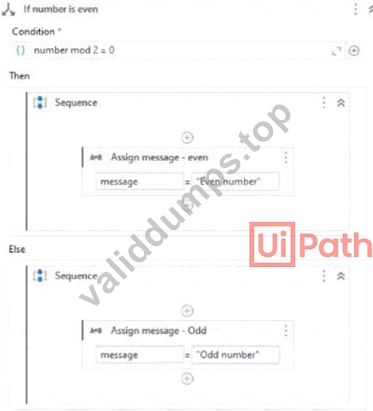
- A. message = lf(number mod 2 = 0 then "Odd number" else "Even number")
- B. message = lf(number mod 2 = 0. "Even number", "Odd number")
- C. message = lf(number mod 2 = 0 {"Odd number"} else {'Even number"})
- D. message = lf(number mod 2 = 0. Odd number. Even number)
Answer: B
Explanation:
This expression evaluates if the number modulo 2 equals 0, which would mean it is even. If true, it assigns the string "Even number" to the variable message. If false (meaning the number is odd), it assigns "Odd number" to message
NEW QUESTION # 73
What Information is provided in the Descriptor Coverage sub-panel of Test Explorer?
- A. Selector coverage
- B. Object Repository coverage
- C. Activity coverage
- D. Test data coverage
Answer: A
Explanation:
The Descriptor Coverage sub-panel in the Test Explorer provides Selector coverage information. This coverage data is crucial for understanding how well the selectors in a project are being tested.
NEW QUESTION # 74
What is a pre-requisite for running functional test cases in REFramework?
- A. Invoke InitAIISettings XAML file
- B. Invoke Main XAML file
- C. Invoke SetTransactionStatus XAML file
- D. Invoke Process XAML file
Answer: A
NEW QUESTION # 75
A developer is building an automation that must interact with a destination remote computer reached by jumping through multiple RDP connections, as described by the following scenario:
- The Robot is installed on Machine A, which connects through RDP to Machine B.
- From Machine B another RDP connection is opened to Machine C, where the automation must be performed.
Which of the following scenarios is appropriate for the developer who wants to use UI Automation activities?
- A. UI Automation can be used and the following are prerequisites:
Machine A - install RDP extension.
Machine B - install RemoteRuntime.msi.
Machine C - install RemoteRuntime.msi. - B. UI Automation can be used and the following are prerequisites:
Machine A - install RDP extension.
Machine B - no requirement.
Machine C - install RemoteRuntime.msi. - C. UI Automation can be used and the following are prerequisites:
Machine A - install RDP extension.
Machine B - install RDP extension and RemoteRuntime.msi.
Machine C - install RemoteRuntime.msi. - D. UI Automation can be used and the following are prerequisites:
Machine A - no requirement.
Machine B - no requirement.
Machine C - install RemoteRuntime.msi.
Answer: C
Explanation:
To use UI Automation activities in a scenario where the destination remote computer is reached by jumping through multiple RDP connections, the following prerequisites are required:
* Machine A - install the RDP extension. This extension enables the robot to generate native selectors over RDP connections and interact with the UI elements on the remote machines.
* Machine B - install the RDP extension and the RemoteRuntime.msi. The RDP extension allows the
* robot to connect to Machine C from Machine B, while the RemoteRuntime component enables the communication between the robot and the UI elements on Machine B.
* Machine C - install the RemoteRuntime.msi. This component enables the communication between the robot and the UI elements on Machine C, where the automation must be performed. References:
[Remote Runtime Architecture], [Multiple RDP Connections], [UiPath Extension for Microsoft Remote Desktop and Apps]
NEW QUESTION # 76
Which part of a test case that is using BDD (Behavioral-Driven Development) template structure supports the Surround with mock feature?
- A. Then
- B. When
- C. Setup
- D. Given
Answer: C
Explanation:
In the BDD (Behavioral-Driven Development) template structure, the "Setup" part of a test case supports the Surround with mock feature. This section is used to set up the testing environment, including mock configurations.
NEW QUESTION # 77
Which one is a feature of UiPath Solutions Management?
- A. Process execution set
- B. Orchestrator bundle
- C. Solution package
- D. Environment-specific configuration file
Answer: C
Explanation:
Solution packagesare part ofUiPath Solutions Management, which helps managecomplex automationsby bundling workflows, dependencies, assets, and configurations together. These packages are used topromote automations between environments, supportversion control, and ensure consistency across deployments.
Reference:UiPath Automation Ops Guide > Solutions Management > Overview
NEW QUESTION # 78
How would you define a linear process in UiPath?
- A. The steps of the process are performed multiple times, but each time different data items are used.
- B. The process steps are performed only once. If the need is to process additional data, then the automation must execute again.
- C. The steps of the process repeat multiple times over different data items. However, the automation design is such that each repeatable part processes independently.
- D. The steps of the process refer to the execution of steps in a sequential manner, where each subsequent step depends on the successful completion of the previous step.
Answer: B
NEW QUESTION # 79
What distinguishes the Settings sheet from the Assets sheet in the "Config.xlsx" file?
- A. Settings sheet contains hard-coded values. Assets sheet contains all names of Orchestrator Assets including those of type Credential.
- B. Settings sheet contains Credential Assets stored in Orchestrator. Assets sheet contains hard-coded values.
- C. Settings sheet contains hard-coded values. Assets sheet contains all names of Orchestrator Assets except those of type Credential.
- D. Settings sheet contains only values used for the initialization of applications. Assets sheet contains only Credential Assets stored in Orchestrator.
Answer: A
NEW QUESTION # 80
In the context of a UiPath State Machine, what is the primary purpose of the Exit action in a state?
- A. To revoke any entry actions performed when entering the current state.
- B. To execute the final actions of the current state before transitioning to the next stage.
- C. To manually stop the state machine's execution.
- D. To define the conditions upon which a state transition should occur.
Answer: B
Explanation:
The Exit action in a state is an activity or a sequence of activities that are executed when the state is exited, before the transition to the next state occurs1. The purpose of the Exit action is to perform any final actions of the current state, such as closing applications, releasing resources, logging information, etc. The Exit action is executed even if the state transitions back to the same state2.
Option A is incorrect, because the Exit action does not stop the state machine's execution, but rather prepares the state for the next transition. Option C is incorrect, because the Exit action does not revoke any entry actions, but rather complements them with any necessary exit actions. Option D is incorrect, because the Exit action does not define the conditions for the state transition, but rather executes after the conditions are evaluated.
References: 1: State 2: State Machines - Exit workflow and Trigger
NEW QUESTION # 81
In a UiPath State Machine workflow, which section of State activity is used to specify conditional/triggers logic and multiple outgoing transitions in a state machine?
- A. Triggers
- B. Transitions
- C. Exit
- D. Entry
Answer: B
Explanation:
In a UiPath State Machine workflow, the Transitions section of the State activity is used to specify conditional/triggers logic and multiple outgoing transitions in a state machine. Transitions are expanded when you double-click them, just like the State activity. They contain three sections: Trigger, Condition and Action, that enable you to add a trigger for the next state, or add a condition under which an activity or sequence is to be executed. Transitions are represented by arrows or branches between states. They define the flow of the state machine and the rules for moving from one state to another. You can add multiple transitions from a state, but only one transition can be taken at a time, based on the trigger or condition that is met first
NEW QUESTION # 82
What are the components that define a state within a State Machine in UiPath Studio?
- A. Sequence, Flowchart, and Transactional Business Process.
- B. Activities, Connectors, and Annotations.
- C. Entry, Exit, and Transition Actions with Trigger Conditions.
- D. Input Arguments, Output Arguments, and Variables.
Answer: C
Explanation:
A state machine is a type of automation that uses a finite number of states in its execution. It can go into a state when it is triggered by an activity, and it exits that state when another activity is triggered1. A state machine consists of states, transitions, and actions1. The components that define a state within a state machine in UiPath Studio are:
*Entry Actions: These are the activities that are executed when the state is entered1. For example, an entry action can be used to initialize a variable, display a message, or log some information1.
*Exit Actions: These are the activities that are executed when the state is exited1. For example, an exit action can be used to clean up some resources, close an application, or update a status1.
*Transition Actions: These are the activities that are executed when a transition from one state to another occurs1. For example, a transition action can be used to assign a value, send an email, or invoke a workflow1.
*Trigger Conditions: These are the conditions that determine when a transition from one state to another should happen1. For example, a trigger condition can be based on a variable value, a user input, or a timer1.
NEW QUESTION # 83
Which of the following options is correct regarding the below Object Repository tree structure?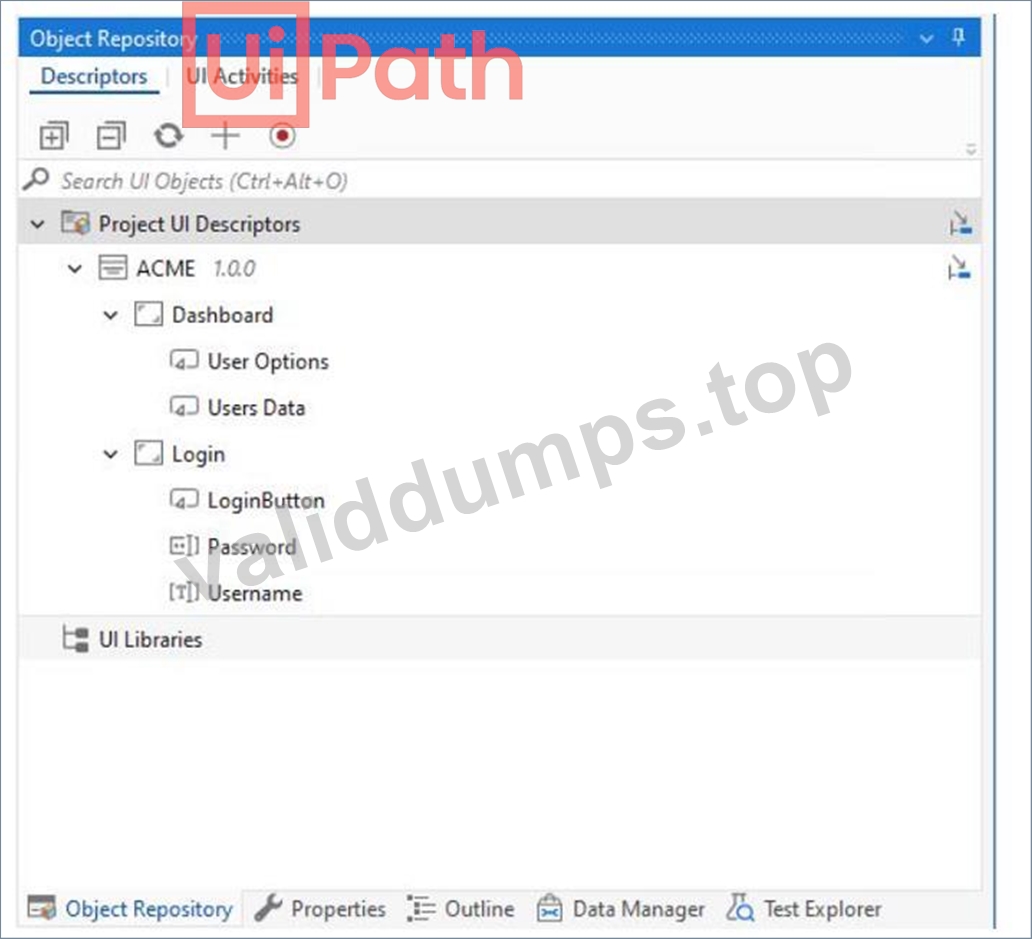
- A. One ScreenTwo ApplicationsTwo UI Elements
- B. One ScreenTwo ApplicationsFive UI Elements
- C. One ApplicationTwo ScreensFive UI Elements
- D. One ApplicationTwo UI ElementsFive Screens
Answer: C
Explanation:
Based on the provided screenshot of the Object Repository tree structure in UiPath, the correct hierarchy and count of elements are as follows:
* There is one Application, which is "ACME 1.0.0".
* Within this application, there are two Screens: "Dashboard" and "Login".
* Under the "Dashboard" screen, there are three UI Elements: "User Options", "Users Data".
* Under the "Login" screen, there are two UI Elements: "LoginButton", "Password", "Username".
Therefore, the correct option regarding the tree structure displayed would be:
C: One Application Two Screens Five UI Elements
This option correctly identifies one application (ACME 1.0.0), two screens (Dashboard, Login), and five UI elements (User Options, Users Data, LoginButton, Password, Username).
NEW QUESTION # 84
A developer wants to add items to a list of strings using the Invoke Method activity. The list is declared as follows: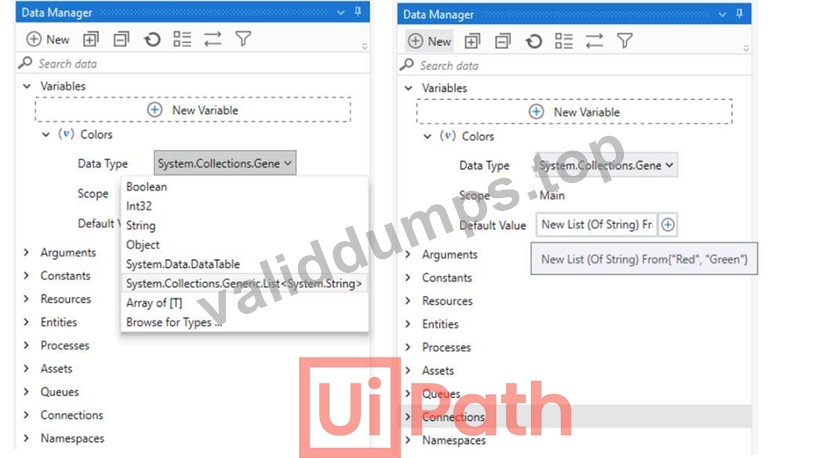
The Invoke Method includes the following properties: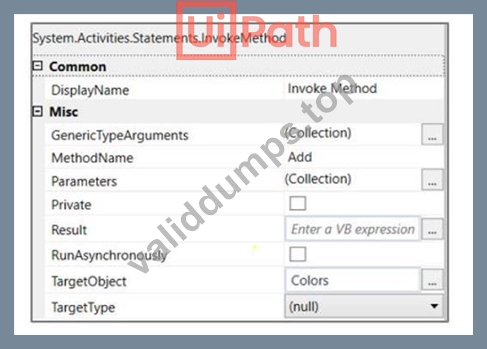
The Invoke Method includes the following properties: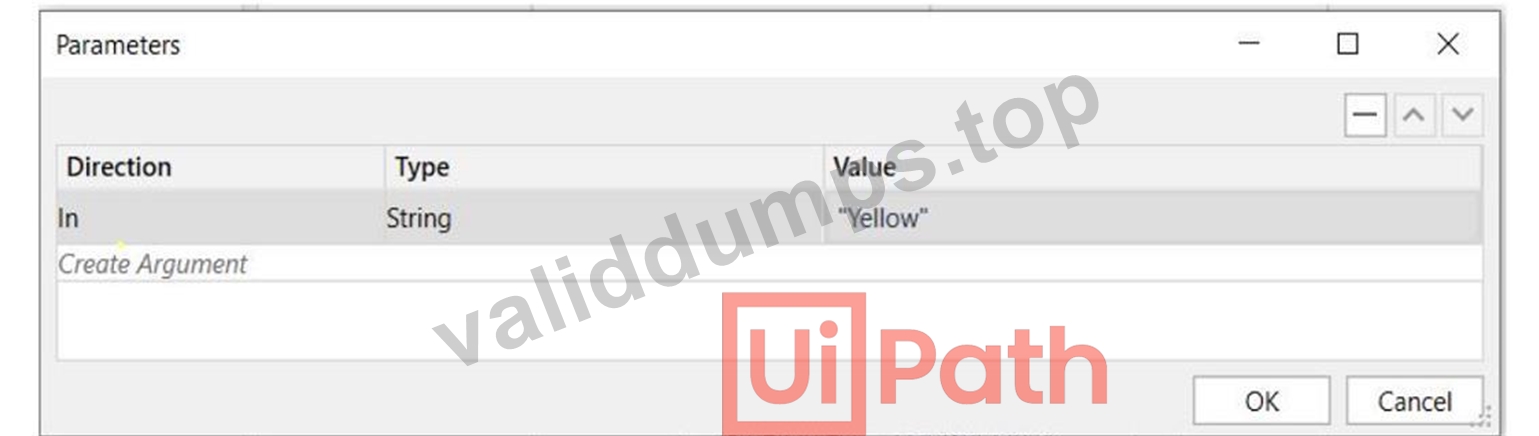
Based on the exhibits, what is the outcome of this Invoke Method activity?
- A. Colors will contain items in the following order: "Red", "Green".
- B. Colors will contain items in the following order: "Red", "Green", "Yellow".
- C. Colors will contain items in the following order: "Yellow", "Red", "Green".
- D. Invoke Method activity will throw an error.
Answer: B
Explanation:
Based on the exhibits provided, the developer has set up an Invoke Method activity to add an item to the
"Colors" list variable. The list is initially declared with two items "Red" and "Green". The Invoke Method activity is configured to add the string "Yellow" to this list.
The properties of the Invoke Method activity indicate that the method 'Add' will be called on the target object
'Colors' with the parameter "Yellow". This means the string "Yellow" will be added to the end of the list.
The outcome of executing this Invoke Method activity will be:
D: Colors will contain items in the following order: "Red", "Green", "Yellow".
This is because items in a List<T> in .NET are added in sequence, and the "Add" method appends the new item to the end of the list.
NEW QUESTION # 85
Which of the options below is not an action in Test Explorer?
- A. Run All In View
- B. Run Selected
- C. Run Failed Test Cases
- D. Run Passed Test Cases
Answer: D
Explanation:
The Test Explorer panel in UiPath Studio shows information relevant to test automation, such as test cases, test results, and activity coverage1. You can use the Test Explorer toolbar to filter test results based on result state, and to run or debug test cases using various options1. According to the UiPath documentation12, the available actions in Test Explorer are:
Refresh: Refresh the information shown in the Test Results panel.
Clear execution results: Clear all execution results shown in the Test Explorer Panel.
Run All in View: Run tests that are currently in view through all filters.
Run All: Run all test cases and workflows.
Run Selected: Run only selected test cases and workflows.
Run Failed Test Cases: Run only failed test cases.
Debug Selected: Debug only selected test cases and workflows.
Debug Failed Test Cases: Debug only failed test cases.
Repeat Last Test Run: Run the latest test.
Passed Test Cases: Show only test cases that have passed.
Failed Test Cases: Show only test cases that have failed.
Not Executed Test Cases: Show only test cases that have not been executed.
Filter by Covered/Uncovered Activities: Choose whether to show in the Designer panel the activities that have been covered during the execution.
Filter by Test Cases/Workflows: Choose what to show in the Test Explorer panel.
Search Tests: Use the search function to look for test case names.
As you can see, there is no action called Run Passed Test Cases in Test Explorer, so this is the correct answer to the question.
References:
Studio - Test Explorer - UiPath Documentation Portal
Studio - Test Activities - UiPath Documentation Portal
Studio - Test Explorer - UiPath Documentation Portal
NEW QUESTION # 86
......
UiPath UiPath-ADPv1 Exam Syllabus Topics:
| Topic | Details |
|---|---|
| Topic 1 |
|
| Topic 2 |
|
| Topic 3 |
|
| Topic 4 |
|
Latest 100% Passing Guarantee - Brilliant UiPath-ADPv1 Exam Questions PDF: https://pass4sure.validdumps.top/UiPath-ADPv1-exam-torrent.html