


[Aug-2026] Lpi 305-300 Official Cert Guide PDF
Exam 305-300: LPIC-3 Exam 305: Virtualization and Containerization - ValidDumps
To prepare for the LPIC-3 Exam 305, IT professionals can take advantage of a variety of resources, including LPI-approved training courses, study guides, practice exams, and online forums. By studying and practicing these materials, IT professionals can ensure that they are fully prepared to pass the exam and earn the LPIC-3 certification.
NEW QUESTION # 38
What types of cloud-init data sources can be used to configure cloud instances? (Select all that apply)
- A. User data scripts
- B. Metadata service
- C. QR codes
- D. Cloud-based configuration management tools
Answer: A,B
Explanation:
Cloud-init is a widely used initialization system for cloud instances, allowing configuration at first boot.
According to cloud-init documentation, the two primary data sources used to configure instances aremetadata servicesanduser data scripts.
Ametadata serviceprovides instance-specific information such as hostname, instance ID, networking details, and SSH keys.User data scriptsallow administrators to supply custom configuration instructions, commonly written as shell scripts or cloud-config YAML.
Cloud-based configuration management tools like Ansible or Puppet are not cloud-init data sources; instead, cloud-init may install or trigger them.QR codesare not supported data sources in cloud-init.
Virtualization and cloud documentation clearly identifies metadata and user data as the supported configuration mechanisms. Therefore, the correct answers areB and D.
NEW QUESTION # 39
How do containers share the host OS kernel?
- A. Containers run directly on the host kernel
- B. Containers do not use a kernel
- C. Containers have their own full OS
- D. Containers share the kernel but run isolated user spaces
Answer: D
Explanation:
Containers operate bysharing the host operating system's kernelwhile running inisolated user spaces.
According to containerization documentation, Linux kernel features such asnamespaces and cgroupsprovide process isolation, resource control, and security boundaries between containers.
Each container has its own filesystem, process tree, and network stack, but all containers rely on the same underlying kernel. This design makes containers lightweight and efficient compared to virtual machines, which require separate guest kernels.
Options A and D are incorrect because containers do use the host kernel. Option C is incomplete because it does not mention isolation. Therefore, the correct answer isB.
NEW QUESTION # 40
Virtualization of which hardware component is facilitated by CPUs supporting nested page table extensions, such as Intel Extended Page Table (EPT) or AMD Rapid Virtualization Indexing (RVI)?
- A. IO Cache
- B. Hard Disks
- C. Memory
- D. Host Bus Adapters
- E. Network Interfaces
Answer: C
Explanation:
Nested page table extensions, such as Intel Extended Page Table (EPT) or AMD Rapid Virtualization Indexing (RVI), are hardware features that facilitate the virtualization of memory. They allow the CPU to perform the translation of guest virtual addresses to host physical addresses in a single step, without the need for software-managed shadow page tables. This reduces the overhead and complexity of memory management for virtual machines, and improves their performance and isolation. Nested page table extensions do not directly affect the virtualization of other hardware components, such as network interfaces, host bus adapters, hard disks, or IO cache.
:
Second Level Address Translation - Wikipedia
c - What is use of extended page table? - Stack Overflow
Hypervisor From Scratch - Part 4: Address Translation Using Extended ...
NEW QUESTION # 41
Which of the following statements is true regarding the following output ofxl list: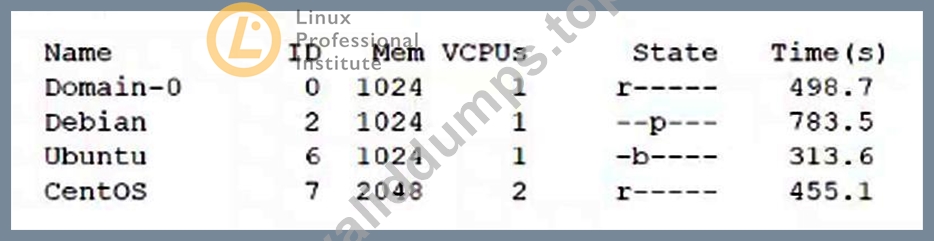
- A. It is necessary to use the xl command to change Ubuntu's state to running.
- B. Both Debian and Ubuntu require xl commands to start running.
- C. CentOS is the domain which has consumed the most CPU time.
- D. The domain with ID 2 uses Para virtualization.
- E. Ubuntu is idle or waiting for I/O.
Answer: E
Explanation:
The output of xl list shows the state of the domains. The domain with ID 6, Ubuntu, has a state of "b-". This means that the domain is blocked, which means it is idle or waiting for I/O.
https://xenbits.xen.org/docs/unstable/man/xl.1.html
NEW QUESTION # 42
A clone of a previously used virtual machine should be created. All VM specific information, such as user accounts, shell histories and SSH host keys should be removed from the cloned disk image. Which of the following tools can perform these tasks?
- A. virt-svspre
- B. vire-wipe
- C. virt-rescue
- D. sysprep
- E. virt-sparsi
- F. virc-reset
Answer: D
Explanation:
Sysprep is a tool that removes all your personal account and security information, and then prepares the machine to be used as an image. It is supported by Windows and some Linux distributions. It can also remove drivers and other machine-specific settings. Sysprep is required when creating a managed image outside of a gallery in Azure
https://learn.microsoft.com/en-us/azure/virtual-machines/generalize
NEW QUESTION # 43
What is libvirt?
- A. A virtualization management API.
- B. A virtualization technology
- C. A hardware virtualization platform
- D. A Linux distribution
Answer: A
Explanation:
Libvirt is avirtualization management API, toolkit, and set of command-line utilitiesdesigned to manage virtualization platforms in a consistent and secure manner. According to official virtualization and containerization documentation, libvirt provides acommon interfacefor interacting with multiple hypervisors such asKVM, QEMU, Xen, VMware ESXi, and Hyper-V, abstracting their underlying differences.
Libvirt itself isnot a virtualization technology or hypervisor; rather, it acts as amanagement layerbetween administrators or orchestration tools and the hypervisor. It enables tasks such as creating, starting, stopping, pausing, migrating, and monitoring virtual machines. Tools likevirshandvirt-managerrely on libvirt to perform virtualization operations.
One of libvirt's key strengths is its focus onsecurity and isolation. It integrates with Linux security frameworks such asSELinux and AppArmor, enforcing mandatory access controls on virtual machines.
Libvirt also supportsremote managementusing secure protocols, making it suitable for enterprise and cloud environments.
In virtualization documentation, libvirt is described as a foundational component forInfrastructure as Code and automation, commonly used with tools likeAnsible, OpenStack, and Kubernetes (via KVM). Its standardized API simplifies virtualization management while ensuring portability, scalability, and compliance with best practices.
NEW QUESTION # 44
Which command within virsh lists the virtual machines that are running on the current host?
- A. list-all
- B. list-vm
- C. list
- D. I view
- E. show
Answer: C
Explanation:
Explanation
The command virsh list is used to list all running domains (VMs) on the current host. The command virsh list
--all can be used to list both active and inactive domains. The other options are not valid virsh commands. The command virsh list is a basic command that lists all running domains (VMs). You can also list all configured VMs by adding the --all option. This is useful if you want to see all VMs configured in the target hypervisor that you can use on subsequent commands1. References:
* 1: 8 Linux virsh subcommands for managing VMs on the command line | Enable Sysadmin.
NEW QUESTION # 45
FILL BLANK
What is the default path to the Docker daemon configuration file on Linux? (Specify the full name of the file,Including path.)
Answer:
Explanation:
/etc/docker/daemon.json
NEW QUESTION # 46
A clone of a previously used virtual machine should be created. All VM specific information, such as user accounts, shell histories and SSH host keys should be removed from the cloned disk image. Which of the following tools can perform these tasks?
- A. virt-svspre
- B. vire-wipe
- C. virt-rescue
- D. sysprep
- E. virt-sparsi
- F. virc-reset
Answer: D
Explanation:
Explanation
Sysprep is a tool that removes all your personal account and security information, and then prepares the machine to be used as an image. It is supported by Windows and some Linux distributions. It can also remove drivers and other machine-specific settings. Sysprep is required when creating a managed image outside of a gallery in Azure
https://learn.microsoft.com/en-us/azure/virtual-machines/generalize
NEW QUESTION # 47
How does Packer interact with system images?
- A. Packer installs a client within the image which has to be run periodically via cron in order to retrieve the latest template from the Packer server and apply it locally.
- B. Packer periodically connects through the network to the Packer daemons of all running Packer images in order to re-apply the whole template to the running instance.
- C. Packer has to be installed within the target image and is executed during the image's first boot in order to execute preparation tasks.
- D. Packer downloads and extracts an image in order to make changes to the image's file system, repack the modified image and upload it again.
- E. Packer creates an instance based on a source image, prepares the instance through a network connection and bundles the resulting instance as a new system image.
Answer: E
NEW QUESTION # 48
Which of the following commands executes a command in a running LXC container?
- A. lxc-run
- B. lxc-eval
- C. lxc-accach
- D. lxc-enter
- E. lxc-batch
Answer: C
Explanation:
The command lxc-attach is used to execute a command in a running LXC container. It allows the user to start a process inside the container and attach to its standard input, output, and error streams1. For example, the command lxc-attach -n mycontainer -- ls -lh /home will list all the files and directories in the /home directory of the container named mycontainer1. The other options are not valid LXC commands. The command lxc- batch does not exist. The command lxc-run is an alias for lxc-start, which is used to start a container, not to execute a command in it2. The command lxc-enter is also an alias for lxc-attach, but it is deprecated and should not be used3. The command lxc-eval is also not a valid LXC command. References:
* 1: Executing a command inside a running LXC - Unix & Linux Stack Exchange.
* 2: lxc-start: start a container. - SysTutorials.
* 3: lxc-attach: start a process inside a running container. - SysTutorials.
NEW QUESTION # 49
Which command was used in Xen 3.x as a predecessor of the xl command?
Answer:
Explanation:
xm
Explanation:
In Xen 3.x, the primary command-line tool used to manage virtual machines wasxm. According to Xen virtualization documentation, xm was part of the original Xen management stack and provided commands to create, start, stop, migrate, and monitor Xen domains.
As Xen evolved, the xm toolstack was deprecated and replaced by thexltoolstack. The xl command interfaces directly with the Xen hypervisor and offers better performance, improved maintainability, and reduced complexity. Modern Xen installations no longer support xm, but it remains historically significant as the predecessor to xl.
Therefore, the correct answer isxm.
NEW QUESTION # 50
Which utility is used to create and manage virtual machine disk images in Linux?
- A. Disk utility
- B. Libvirt Disk Manager
- C. qemu-img
- D. VirtualBox Manager
Answer: C
Explanation:
In Linux-based virtualization environments,qemu-imgis the standard utility used to create, convert, inspect, and manage virtual machine disk images. Virtualization and containerization documentation clearly identifies qemu-img as a core component of theQEMU/KVM virtualization stack. It supports multiple disk image formats such as RAW, QCOW2, VMDK, and VHD, making it highly versatile across different hypervisors and platforms.
The qemu-img tool allows administrators to perform critical disk operations, including creating new disk images, resizing existing images, converting between formats, and checking disk integrity. For example, it is commonly used to createQCOW2 images, which support advanced features like copy-on-write, snapshots, and compression.
Other options listed are incorrect becauseDisk Utilityis a general-purpose storage management tool, VirtualBox Manageris specific to Oracle VirtualBox, andLibvirt Disk Manageris not a recognized standalone utility. Libvirt relies on qemu-img internally for disk image handling.
Official virtualization notes consistently reference qemu-img as theprimary disk image management toolin Linux virtualization environments, especially when working with KVM and libvirt-based systems.
NEW QUESTION # 51
Which of the following statements is true regarding networking with libvirt?
- A. Libvirt's network functionality is limited to connecting virtual machines to a physical network interface of the host system.
- B. Libvirt requires a dedicated network interface that may not be used by the host system.
- C. Libvirt assiqns the same MAC address to all virtual machines and isolates their network interfaces at the link layer.
- D. Libvirt supports exactly one virtual network and connects all virtual machines to it.
- E. Libvirt networks appear, by default, as standard Linux bridges in the host system.
Answer: E
Explanation:
Libvirt supports creating and managing various types of virtual networks that can be used to connect virtual machines to each other or to the external network. One of the common types of virtual networks is the NAT- based network, which uses network address translation (NAT) to allow virtual machines to access the outside world through the host's network interface. By default, libvirt creates a NAT-based network called 'default' when it is installed and started. This network appears as a standard Linux bridge device on the host system, named virbr0. The bridge device has an IP address of 192.168.122.1/24 and acts as a gateway and a DHCP server for the virtual machines connected to it. The bridge device also has iptables rules to forward and masquerade the traffic from and to the virtual machines. The virtual machines connected to the 'default' network have their own IP addresses in the 192.168.122.0/24 range and their own MAC addresses generated by libvirt. The virtual machines can communicate with each other, with the host, and with the external network through the bridge device and the NAT mechanism12.
The other statements in the question are false regarding networking with libvirt. Libvirt's network functionality is not limited to connecting virtual machines to a physical network interface of the host system. Libvirt can also create isolated networks that do not have any connection to the outside world, or routed networks that use static routes to connect virtual machines to the external network without NAT3.
Libvirt does not assign the same MAC address to all virtual machines and isolate their network interfaces at the link layer. Libvirt assigns a unique MAC address to each virtual machine and allows them to communicate with each other at the network layer4. Libvirt does not require a dedicated network interface that may not be used by the host system. Libvirt can share the host's network interface with the virtual machines using NAT or bridging, or it can pass a physical network interface to a virtual machine exclusively using PCI passthrough5. Libvirt does not support exactly one virtual network and connect all virtual machines to it. Libvirt supports creating and managing multiple virtual networks with different names and configurations, and connecting virtual machines to different networks according to their needs6. References:
* libvirt: Virtual Networking
* libvirt: NAT forwarding (aka "virtual networks")
* libvirt: Routed network
* libvirt: MAC address
* libvirt: PCI passthrough of host network devices
* [libvirt: Network XML format]
NEW QUESTION # 52
After creating a new Docker network using the following command:
docker network create --driver bridge isolated_nw
which parameter must be added todocker createin order to attach a container to the network?
- A. --attach=isolated_nw
- B. --alias=isolated_nw
- C. --ethernet=isolated_nw
- D. --eth0=isolated_nw
- E. --network=isolated_nw
Answer: E
Explanation:
Explanation
To attach a container to a network when creating it, the --network flag must be used with the name of the network as the argument. The --network flag specifies the network mode for the container. By default, the network mode is bridge, which means the container is connected to the default bridge network. However, if a custom network is created, such as isolated_nw in this case, the container must be explicitly attached to it using the --network flag. For example, to create a container named web1 and attach it to the isolated_nw network, the command would be:
docker create --name web1 --network isolated_nw nginx
The other options are not valid parameters for docker create. The --eth0, --ethernet, and --attach flags do not exist. The --alias flag is used to specify an additional network alias for the container on a user-defined network, but it does not attach the container to the network. References:
* docker network create | Docker Documentation1
* docker create | Docker Documentation
* Networking overview | Docker Docs2
NEW QUESTION # 53
Which of the following network interface types are valid in an LXD container configuration? (Choose three.)
- A. physical
- B. wifi
- C. macvlan
- D. bridged
- E. ipsec
Answer: A,C,D
NEW QUESTION # 54
Which of the following are true regarding the CPU of a QEMU virtual machine? (Choose two.)
- A. Each QEMU virtual machine can only have one CPU with one core.
- B. The CPU architecture of a QEMU virtual machine is independent of the host system's architecture.
- C. For each QEMU virtual machine, one dedicated physical CPU core must be reserved.
- D. QEMU virtual machines support multiple virtual CPUs in order to run SMP systems.
- E. QEMU uses the concept of virtual CPUs to map the virtual machines to physical CPUs.
Answer: B,D
Explanation:
Explanation
The CPU architecture of a QEMU virtual machine is independent of the host system's architecture. QEMU can emulate many CPU architectures, including x86, ARM, Alpha, and SPARC, regardless of the host system's architecture1. This allows QEMU to run guest operating systems that are not compatible with the host system's hardware. Therefore, option A is correct. QEMU virtual machines support multiple virtual CPUs in order to run SMP systems. QEMU uses the concept of virtual CPUs (vCPUs) to map the virtual machines to physical CPUs. Each vCPU is a thread that runs on a physical CPU core. QEMU allows the user to specify the number of vCPUs and the CPU model for each virtual machine. QEMU can run SMP systems with multiple vCPUs, as well as single-processor systems with one vCPU2. Therefore, option E is also correct. The other options are incorrect because they do not describe the CPU of a QEMU virtual machine. Option B is wrong because QEMU virtual machines can have more than one CPU with more than one core. Option C is wrong because QEMU does not require a dedicated physical CPU core for each virtual machine. QEMU can share the physical CPU cores among multiple virtual machines, depending on the load and the scheduling policy.
Option D is wrong because QEMU does not use the term CPU, but vCPU, to refer to the virtual machines' processors. References:
* QEMU vs VirtualBox: What's the difference? - LinuxConfig.org
* QEMU / KVM CPU model configuration - QEMU documentation
* Introduction - QEMU documentation
* Qemu/KVM Virtual Machines - Proxmox Virtual Environment
NEW QUESTION # 55
Which directory is used bycloud-initto store status information and configuration information retrieved from external sources?
- A. /opt/cloud/var/
- B. /var/lib/cloud/
- C. /proc/sys/cloud/
- D. /etc/cloud-init/cache/
- E. /tmp/.cloud/
Answer: B
Explanation:
Explanation
cloud-init uses the /var/lib/cloud/ directory to store status information and configuration information retrieved from external sources, such as the cloud platform'smetadata service or user data files. The directory contains subdirectories for different types of data, such as instance, data, handlers, scripts, and sem. The instance subdirectory contains information specific to the current instance, such as the instance ID, the user data, and the cloud-init configuration. The data subdirectory contains information about the data sources that cloud-init detected and used. The handlers subdirectory contains information about the handlers that cloud-init executed.
The scripts subdirectory contains scripts that cloud-init runs at different stages of the boot process, such as per-instance, per-boot, per-once, and vendor. The sem subdirectory contains semaphore files that cloud-init uses to track the execution status of different modules and stages. References:
* Configuring and managing cloud-init for RHEL 8 - Red Hat Customer Portal
* vsphere - what is the linux file location where the cloud-init user ...
NEW QUESTION # 56
......
Free 305-300 Exam Dumps to Improve Exam Score: https://pass4sure.validdumps.top/305-300-exam-torrent.html