


[UPDATED 2024] 305-300 dumps Free Test Engine Verified By Certified Experts
Realistic 305-300 Accurate & Verified Answers As Experienced in the Actual Test!
To prepare for the LPI 305-300 certification exam, candidates should have a solid foundation in virtualization and containerization technologies. They should also have practical experience working with virtualization and containerization software, such as Docker, Kubernetes, and VMware. Candidates may also benefit from taking training courses or studying exam preparation materials to brush up on the exam's topics and objectives.
The LPI 305-300 exam, also known as the LPIC-3 Exam 305: Virtualization and Containerization, is a professional certification exam designed for IT professionals seeking to advance their skills and knowledge in virtualization and containerization technologies. 305-300 exam is designed to test the candidate's ability to design, deploy, and manage virtualized and containerized environments using various tools and technologies.
NEW QUESTION # 18
A clone of a previously used virtual machine should be created. All VM specific information, such as user accounts, shell histories and SSH host keys should be removed from the cloned disk image. Which of the following tools can perform these tasks?
- A. virc-reset
- B. virt-svspre
- C. virt-sparsi
- D. sysprep
- E. virt-rescue
- F. vire-wipe
Answer: B
NEW QUESTION # 19
What kind of virtualization is implemented by LXC?
- A. Hardware containers
- B. System containers
- C. Paravirtualization
- D. CPU emulation
- E. Application containers
Answer: B
NEW QUESTION # 20
What kind of virtualization is implemented by LXC?
- A. Hardware containers
- B. System containers
- C. Paravirtualization
- D. CPU emulation
- E. Application containers
Answer: B
Explanation:
Explanation
LXC implements system containers, which are a type of operating-system-level virtualization. System containers allow running multiple isolated Linux systems on a single Linux control host, using a single Linux kernel. System containers share the same kernel with the host and each other, but have their own file system, libraries, andprocesses. System containers are different from application containers, which are designed to run a single application or service in an isolated environment. Application containers are usually smaller and more portable than system containers, but also more dependent on the host kernel and libraries. Hardware containers, CPU emulation, and paravirtualization are not related to LXC, as they are different kinds of virtualization methods that involve hardware abstraction, instruction translation, or modification of the guest operating system. References:
* 1: LXC - Wikipedia
* 2: Linux Virtualization : Linux Containers (lxc) - GeeksforGeeks
* 3: Features - Proxmox Virtual Environment
NEW QUESTION # 21
FILL BLANK
What is the default path to the Docker daemon configuration file on Linux? (Specify the full name of the file,Including path.)
Answer:
Explanation:
/etc/docker/daemon.json
Explanation
The default path to the Docker daemon configuration file on Linux is /etc/docker/daemon.json. This file is a JSON file that contains the settings and options for the Docker daemon, which is the service that runs on the host operating system and manages the containers, images, networks, and other Docker resources. The
/etc/docker/daemon.json file does not exist by default, but it can be created by the user to customize the Docker daemon behavior. The file can also be specified by using the --config-file flag when starting the Docker daemon. The file must be a valid JSON object and follow the syntax and structure of the dockerd reference docs12. References:
* Docker daemon configuration file - Medium3
* Docker daemon configuration overview | Docker Docs4
* docker daemon | Docker Docs5
NEW QUESTION # 22
After creating a new Docker network using the following command:
docker network create --driver bridge isolated_nw
which parameter must be added todocker createin order to attach a container to the network?
- A. --alias=isolated_nw
- B. --network=isolated_nw
- C. --ethernet=isolated_nw
- D. --attach=isolated_nw
- E. --eth0=isolated_nw
Answer: B
Explanation:
Explanation
To attach a container to a network when creating it, the --network flag must be used with the name of the network as the argument. The --network flag specifies the network mode for the container. By default, the network mode is bridge, which means the container is connected to the default bridge network. However, if a custom network is created, such as isolated_nw in this case, the container must be explicitly attached to it using the --network flag. For example, to create a container named web1 and attach it to the isolated_nw network, the command would be:
docker create --name web1 --network isolated_nw nginx
The other options are not valid parameters for docker create. The --eth0, --ethernet, and --attach flags do not exist. The --alias flag is used to specify an additional network alias for the container on a user-defined network, but it does not attach the container to the network. References:
* docker network create | Docker Documentation1
* docker create | Docker Documentation
* Networking overview | Docker Docs2
NEW QUESTION # 23
After setting up a data container using the following command:
docker create -v /data --name datastore debian /bin/true
how is an additional new container started which shares the/datavolume with the datastore container?
- A. docker run -v /data --name service debian bash
- B. docker run --share-with datastore --name service debian bash
- C. docker run -v datastore:/data --name service debian bash
- D. docker run --volumes-from datastore --name service debian bash
- E. docker run --volume-backend datastore -v /data --name service debian bash
Answer: D
NEW QUESTION # 24
Which of the following statements in aDockerfileleads to a container which outputs hello world? (Choose two.)
- A. ENTRYPOINT echo Hello World
- B. ENTRYPOINT "echo Hello World"
- C. ENTRYPOINT [ "echo hello world" ]
- D. ENTRYPOINT "echo", "Hello", "World*
- E. ENTRYPOINT [ "echo", "hello", "world" ]
Answer: C,E
Explanation:
Explanation
The ENTRYPOINT instruction in a Dockerfile specifies the default command to run when a container is started from the image. The ENTRYPOINT instruction can be written in two forms: exec form and shell form.
The exec form uses a JSON array to specify the command and its arguments, such as [ "executable",
"param1", "param2" ]. The shell form uses a single string to specify the command and its arguments, such as
"executable param1 param2". The shell form is converted to the exec form by adding /bin/sh -c to the beginning of the command. Therefore, the following statements in a Dockerfile are equivalent and will lead to a container that outputs hello world:
ENTRYPOINT [ "echo hello world" ] ENTRYPOINT [ "/bin/sh", "-c", "echo hello world" ] ENTRYPOINT
"echo hello world" ENTRYPOINT [ "echo", "hello", "world" ] ENTRYPOINT [ "/bin/sh", "-c", "echo",
"hello", "world" ] ENTRYPOINT "echo hello world"
The other statements in the question are invalid or incorrect. The statement A. ENTRYPOINT "echo Hello World" is invalid because it uses double quotes to enclose the entire command, which is not allowed in the shell form. The statement D. ENTRYPOINT echo Hello World is incorrect because it does not use quotes to enclose the command, which is required in the shell form. The statement E. ENTRYPOINT "echo", "Hello",
"World" is invalid because it uses double quotes to separate the command and its arguments, which is not allowed in the exec form. References:
* Dockerfile reference | Docker Docs
* Using the Dockerfile ENTRYPOINT and CMD Instructions - ATA Learning
* Difference Between run, cmd and entrypoint in a Dockerfile
NEW QUESTION # 25
FILL BLANK
What is the default path to the Docker daemon configuration file on Linux? (Specify the full name of the file,Including path.)
Answer:
Explanation:
/etc/docker/daemon.json
NEW QUESTION # 26
The commandvirsh vol-list vmsreturns the following error:
error: failed to get pool 'vms'
error: Storage pool not found: no storage pool with matching name 'vms ' Given that the directory/vmsexists, which of the following commands resolves this issue?
- A. dd if=/dev/zero of=/vms bs=1 count=0 flags=name:vms
- B. qemu-img pool vms:/vms
- C. virsh pool-create-as vms dir --target /vms
- D. touch /vms/.libvirtpool
- E. libvirt-poolctl new --name=/vms --type=dir --path=/vms
Answer: C
NEW QUESTION # 27
Which of the following tasks are part of a hypervisor's responsibility? (Choose two.)
- A. Create filesystems during the installation of new virtual machine quest operating systems.
- B. Map the resources of virtual machines to the resources of the host system.
- C. Isolate the virtual machines and prevent unauthorized access to resources of other virtual machines.
- D. Manage authentication to network services running inside a virtual machine.
- E. Provide host-wide unique PIDs to the processes running inside the virtual machines in order to ease inter-process communication between virtual machines.
Answer: B,C
NEW QUESTION # 28
Which of the following commands lists all differences between the disk images vm1-snap.img and vm1.img?
- A. virt-history -a vm1-snap.img -A vm1.img
- B. virt-diff -a vm1-snap.img -A vm1.img
- C. virt-cp-in -a vm1-snap.img -A vm1.img
- D. virt-cmp -a vm1-snap.img -A vm1.img
- E. virt-delta -a vm1-snap.img -A vm1.img
Answer: B
Explanation:
Explanation
The virt-diff command-line tool can be used to list the differences between files in two virtual machines or disk images. The output shows the changes to a virtual machine's disk images after it has been running. The command can also be used to show the difference between overlays1. To specify two guests, you have to use the -a or -d option for the first guest, and the -A or -D option for the second guest. For example: virt-diff -a old.img -A new.img1. Therefore, the correct command to list all differences between the disk images vm1-snap.img and vm1.img is: virt-diff -a vm1-snap.img -A vm1.img. The other commands are not related to finding differences between disk images. virt-delta is a tool to create delta disks from two disk images2. virt-cp-in is a tool to copy files and directories into a virtual machine disk image3. virt-cmp is a tool to compare two files or directories in a virtual machine disk image4. virt-history is a tool to show the history of a virtual machine disk image5. References:
* 21.13. virt-diff: Listing the Differences between Virtual Machine Files ...
* 21.14. virt-delta: Creating Delta Disks from Two Disk Images ...
* 21.6. virt-cp-in: Copying Files and Directories into a Virtual Machine Disk Image ...
* 21.7. virt-cmp: Comparing Two Files or Directories in a Virtual Machine Disk Image ...
* 21.8. virt-history: Showing the History of a Virtual Machine Disk Image ...
NEW QUESTION # 29
Which of the following statements is true regarding the following output ofxl list: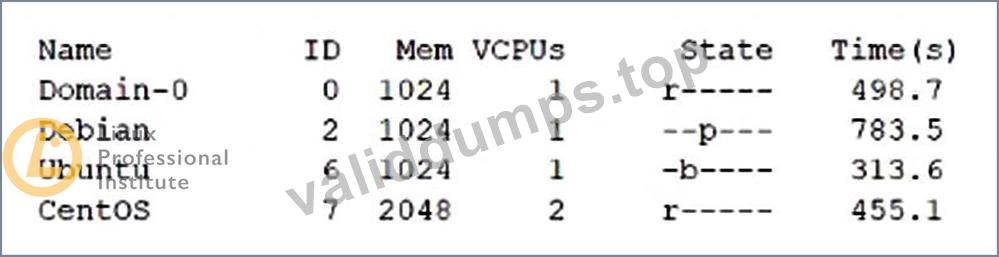
- A. The domain with ID 2 uses Para virtualization.
- B. Both Debian and Ubuntu require xl commands to start running.
- C. Ubuntu is idle or waiting for I/O.
- D. CentOS is the domain which has consumed the most CPU time.
- E. It is necessary to use the xl command to change Ubuntu's state to running.
Answer: C
Explanation:
Explanation
The output of xl list shows the state of the domains. The domain with ID 6, Ubuntu, has a state of "b-". This means that the domain is blocked, which means it is idle or waiting for I/O.
https://xenbits.xen.org/docs/unstable/man/xl.1.html
NEW QUESTION # 30
What is the purpose of a .dockerignore file?
- A. It specifies files that Docker does not submit to the Docker daemon when building a Docker image
- B. It must be placed in the top level directory of volumes that Docker should never attach automatically to a container
- C. It specifies which parts of a Dockerfile should be ignored when building a Docker image.
- D. It exists in the root file system of containers that should ignore volumes and ports provided by Docker.
- E. It lists files existing in a Docker image which should be excluded when building a derivative image.
Answer: A
Explanation:
Explanation
The purpose of a .dockerignore file is to specify files that Docker does not submit to the Docker daemon when building a Docker image. A .dockerignore file is a text file that contains a list of files or directories that should be excluded from the build context, which is the set of files and folders that are available for use in a Dockerfile. By using a .dockerignore file, you can avoid sending files or directories that are large, contain sensitive information, or are irrelevant to the Docker image to the daemon, which can improve the efficiency and security of the build process. The other options are incorrect because they do not describe the function of a
.dockerignore file. Option A is wrong because a .dockerignore file does not affect the files existing in a Docker image, but only the files sent to the daemon during the build. Option C is wrong because a .dockerignore file does not exist in the root file system of containers, but in the same directory as the Dockerfile. Option D is wrong because a .dockerignore file does not affect the volumes that Docker attaches to a container, but only the files included in the build context. Option E is wrong because a .dockerignore file does not affect the parts of a Dockerfile that are executed, but only the files available for use in a Dockerfile. References:
* What are .dockerignore files, and why you should use them?
* Dockerfile reference | Docker Docs
* How to use .dockerignore and its importance - Shisho Cloud
NEW QUESTION # 31
Which of the following statements are true regarding a Pod in Kubernetes? (Choose two.)
- A. When a Pod fails, Kubernetes restarts the Pod on another node by default.
- B. All containers of a Pod run on the same node.
- C. Pods are always created automatically and cannot be explicitly configured.
- D. A Pod is the smallest unit of workload Kubernetes can run.
- E. systemd is used to manage individual Pods on the Kubernetes nodes.
Answer: B,D
Explanation:
Explanation
A Pod in Kubernetes is a collection of one or more containers that share the same network and storage resources, and a specification for how to run the containers. A Pod is the smallest unit of workload Kubernetes can run, meaning that it cannot be divided into smaller units. Therefore, option C is correct. All containers of a Pod run on the same node, which is the smallest unit of computing hardware in Kubernetes. A node is a physical or virtual machine that hosts one or more Pods. Therefore, option A is also correct. Pods are not always created automatically and cannot be explicitly configured. Pods can be created manually using YAML or JSON files, or using commands like kubectl run or kubectl create. Pods can also be created automatically by higher-level controllers, such as Deployment, ReplicaSet, or StatefulSet. Therefore, option B is incorrect.
When a Pod fails, Kubernetes does not restart the Pod on another node by default. Pods are ephemeral by nature, meaning that they can be terminated or deleted at any time. If a Pod is managed by a controller, the controller will create a new Pod to replace the failed one, but it may not be on the same node. Therefore, option D is incorrect. systemd is not used to manage individual Pods on the Kubernetes nodes. systemd is a system and service manager for Linux operating systems that can start and stop services, such as docker or kubelet. However, systemd does not interact with Podsdirectly. Pods are managed by the kubelet service, which is an agent that runs on each node and communicates with the Kubernetes control plane. Therefore, option E is incorrect. References:
* Pods | Kubernetes
* What is a Kubernetes pod? - Red Hat
* What's the difference between a pod, a cluster, and a container?
* What are Kubernetes Pods? | VMware Glossary
* Kubernetes Node Vs. Pod Vs.Cluster: Key Differences - CloudZero
NEW QUESTION # 32
Which of the following resources can be limited by libvirt for a KVM domain? (Choose two.)
- A. Amount of CPU lime
- B. Number of running processes
- C. Number of available files
- D. Size of available memory
- E. File systems allowed in the domain
Answer: A,D
Explanation:
Explanation
Libvirt is a toolkit that provides a common API for managing different virtualization technologies, such as KVM, Xen, LXC, and others. Libvirt allows users to configure and control various aspects of a virtual machine (also called a domain), such as its CPU, memory, disk, network, and other resources. Among the resources that can be limited by libvirt for a KVM domain are:
* Amount of CPU time: Libvirt allows users to specify the number of virtual CPUs (vCPUs) that a domain can use, as well as the CPU mode, model, topology, and tuning parameters. Users can also set the CPU shares, quota, and period to control the relative or absolute amount of CPU time that a domain can consume. Additionally, users can pin vCPUs to physical CPUs or NUMA nodes to improve performance and isolation. These settings can be configured in the domain XML file under the <cpu> and <cputune> elements12.
* Size of available memory: Libvirt allows users to specify the amount of memory that a domain can use, as well as the memory backing, tuning, and NUMA node parameters. Users can also set the memory hard and soft limits, swap hard limit, and minimum guarantee to control the memory allocation and reclaim policies for a domain. These settings can be configured in the domain XML file under the <memory>, <memoryBacking>, and <memtune> elements13.
The other resources listed in the question are not directly limited by libvirt for a KVM domain. File systems allowed in the domain are determined by the disk and filesystem devices that are attached to the domain, which can be configured in the domain XML file under the <disk> and <filesystem> elements14. Number of running processes and number of available files are determined by the operating system and the file system of the domain, which are not controlled by libvirt.
References:
* libvirt: Domain XML format
* CPU Allocation
* Memory Allocation
* Hard drives, floppy disks, CDROMs
NEW QUESTION # 33
Which of the following statements is true regarding networking with libvirt?
- A. Libvirt supports exactly one virtual network and connects all virtual machines to it.
- B. Libvirt requires a dedicated network interface that may not be used by the host system.
- C. Libvirt's network functionality is limited to connectingvirtual machines to a physical network interface of the host system.
- D. Libvirt networks appear, by default, as standard Linux bridges in the host system.
- E. Libvirt assiqns the same MAC address to all virtual machines and isolates their network interfaces at the link layer.
Answer: D
NEW QUESTION # 34
In an IaaS cloud, what is a common method for provisioning new computing instances with an operating system and software?
- A. Each new instance is a clone of another currently running instance that includes all the software, data and state of the original instance.
- B. Each new instance contains a minimal live system running from a virtual CD as the basis from which the administrator deploys the target operating system.
- C. Each new instance is connected to the installation media of a Linux distribution and provides access to the installer by logging in via SSH.
- D. Each new instance is connected via a VPN with the computer that started the provisioning and tries to PXE boot from that machine.
- E. Each new instance is created based on an image file that contains the operating system as well as software and default configuration for a given purpose.
Answer: E
NEW QUESTION # 35
Which file format is used by libvirt to store configuration data?
- A. INI-style text files
- B. Java-like properties files
- C. SQLite databases
- D. Text files containing key/value pairs
- E. XML files
Answer: E
NEW QUESTION # 36
Which of the following statements are true regarding resource management for full virtualization? (Choose two.)
- A. The hygervisor may provide fine-grained limits to internal elements of the guest operating system such as the number of processes.
- B. All processes created within the virtual machines are transparently and equally scheduled in the host system for CPU and I/O usage.
- C. The hypervisor provides each virtual machine with hardware of a defined capacity that limits the resources of the virtual machine.
- D. Full virtualization cannot pose any limits to virtual machines and always assigns the host system's resources in a first-come-first-serve manner.
- E. It is up to the virtual machine to use its assigned hardware resources and create, for example, an arbitrary amount of network sockets.
Answer: C,E
Explanation:
Explanation
Resource management for full virtualization is the process of allocating and controlling the physical resources of the host system to the virtual machines running on it. The hypervisor is the software layer that performs this task, by providing each virtual machine with a virtual hardware of a defined capacity that limits the resources of the virtual machine. For example, the hypervisor can specify how many virtual CPUs, how much memory, and how much disk space each virtual machine can use. The hypervisor can also enforce resource isolation and prioritization among the virtual machines, to ensure that they do not interfere with each other or consume more resources than they are allowed to. The hypervisor cannot provide fine-grained limits to internal elements of the guest operating system, such as the number of processes, because the hypervisor does not have access to the internal state of the guest operating system. The guest operating system is responsible for managing its own resources within the virtual hardware provided by the hypervisor. For example, the guest operating system can create an arbitrary amount of network sockets, as long as it does not exceed the network bandwidth allocated by the hypervisor. Full virtualization can pose limits to virtual machines, and does not always assign the host system's resources in a first-come-first-serve manner. The hypervisor can use various resource management techniques, such as reservation, limit, share, weight, and quota, to allocate and control the resources of the virtual machines. The hypervisor can also use resource scheduling algorithms, such as round-robin, fair-share, or priority-based, to distribute the resources among the virtual machines according to their needs and preferences. All processes created within the virtual machines are not transparently and equally scheduled in the host system for CPU and I/O usage. The hypervisor can use different scheduling policies, such as proportional-share, co-scheduling, or gang scheduling, to schedule the virtual CPUs of the virtual machines on the physical CPUs of the host system. The hypervisor can alsouse different I/O scheduling algorithms, such as deadline, anticipatory, or completely fair queuing, to schedule the I/O requests of the virtual machines on the physical I/O devices of the host system. The hypervisor can also use different resource accounting and monitoring mechanisms, such as cgroups, perf, or sar, to measure and report the resource consumption and performance of the virtual machines. References:
* Oracle VM VirtualBox: Features Overview
* Resource Management as an Enabling Technology for Virtualization - Oracle
* Introduction to virtualization and resource management in IaaS | Cloud Native Computing Foundation
NEW QUESTION # 37
How can data be shared between several virtual machines running on the same Linux-based host system?
- A. By setting up a ramdisk in one virtual machine and mounting it using its UUID in the other VMs.
- B. By writing data to the file system since all virtual machines on the same host system use the same file system.
- C. By attaching the same virtual hard disk to all virtual machines and activating EXT4 sharing extensions on it.
- D. By using a network file system or file transfer protocol.
- E. By mounting other virtual machines' file systems from /dev/virt-disks/remote/.
Answer: D
Explanation:
Explanation
The correct way to share data between several virtual machines running on the same Linux-based host system is by using a network file system or file transfer protocol. A network file system (NFS) is a distributed file system protocol that allows a user on a client computer to access files over a network in a manner similar to how local storage is accessed1. A file transfer protocol (FTP) is a standard network protocol used for the transfer of computer files between a client and server on a computer network2. Both methods allow data to be shared between virtual machines regardless of their underlying file systems or virtualization technologies. The other options are incorrect because they either do not work or are not feasible. Option A is wrong because each virtual machine has its own file system that is not directly accessible by other virtual machines. Option B is wrong because there is no such device as /dev/virt-disks/remote/ that can be used to mount other virtual machines' file systems. Option C is wrong because a ramdisk is a volatile storage device that is not suitable for sharing data between virtual machines. Option E is wrong because attaching the same virtual hard disk to multiple virtual machines can cause data corruption and conflicts, and EXT4 does not have any sharing extensions that can prevent this. References:https://kb.vmware.com/s/article/1012706
https://bing.com/search?q=data+sharing+between+virtual+machines
NEW QUESTION # 38
......
The LPIC-3 Exam 305: Virtualization and Containerization certification exam is designed for IT professionals who want to showcase their skills and knowledge in virtualization and containerization technologies. LPIC-3 Exam 305: Virtualization and Containerization certification exam is essential for professionals who want to advance their careers in the field of IT infrastructure and system administration. The LPIC-3 certification is recognized globally as a premier certification for Linux system administration.
Latest Lpi 305-300 Practice Test Questions: https://pass4sure.validdumps.top/305-300-exam-torrent.html